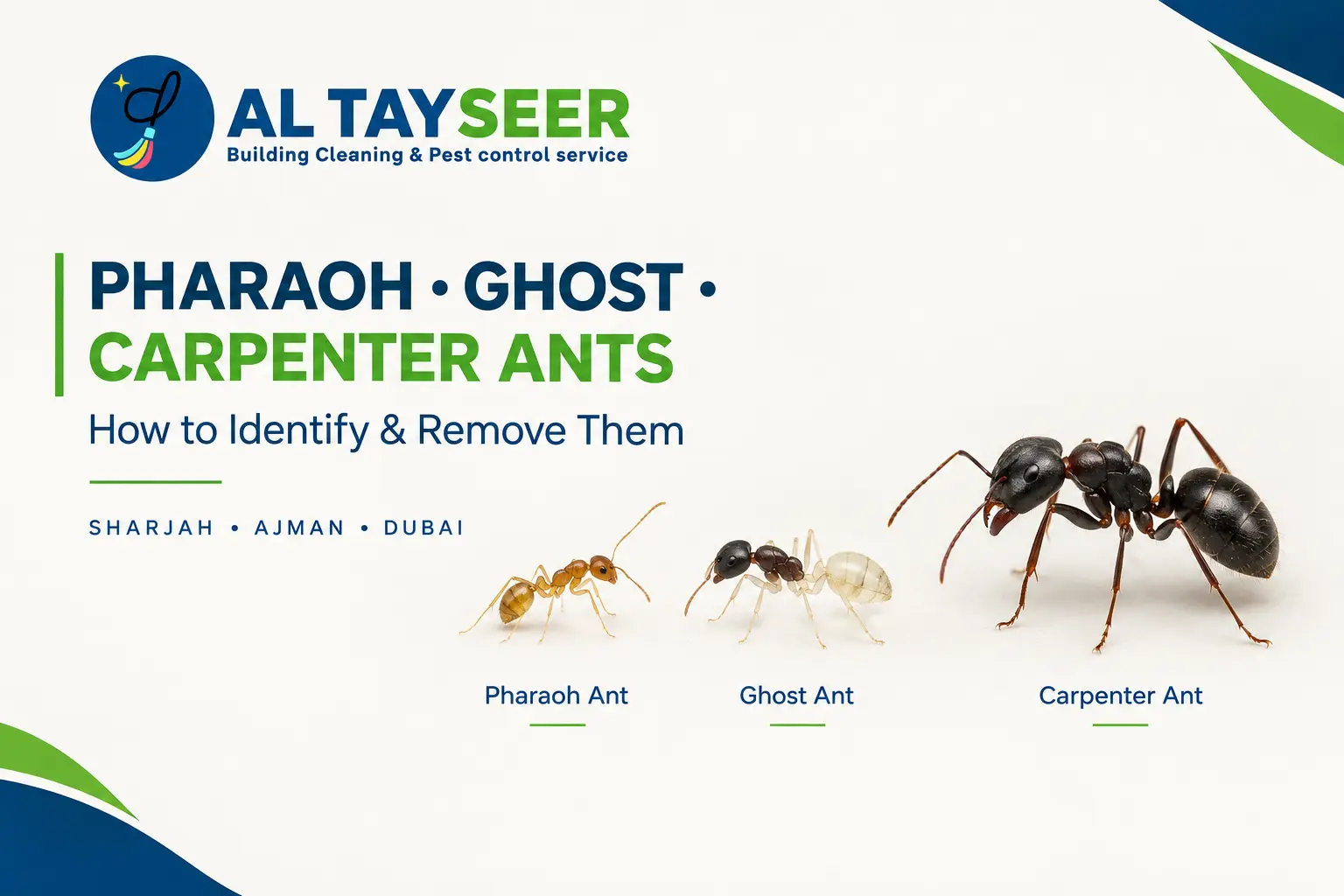
Three different ants, three different nesting habits. If you treat the wrong one, the problem keeps coming back.
A thin trail of ants is easy to wipe away, but the wrong spray can spread a colony instead of ending it. Pharaoh ants and ghost ants are both tiny, about 1.5 to 2 mm, while carpenter ants are much bigger, roughly 7 to 13 mm. This guide helps residents in Dubai, Sharjah, and Ajman tell them apart and know what to do about each one.
1. Why Ants Show Up in Dubai, Sharjah & Ajman Homes
Ants want food, water and a safe place to nest, and in a hot, dry climate the water often matters most. The University of California's IPM program points out that dry, hot spells push ants indoors to look for water, sometimes as far as bathroom taps and drains.
The UAE adds a local twist. A survey of the country's introduced ants found that they flourish around people, in built-up and moist places, and stop short of the open sand desert. So the ants in a kitchen in Sharjah, Ajman, and Dubai are often tramp species, meaning ants that spread through human trade and settle wherever there is food, water and shelter. AntWiki's UAE checklist lists 126 ant species and subspecies, and 14 of them are introduced.
2. How to Recognise a Pharaoh Ant
Pharaoh ants (Monomorium pharaonis) are tiny, yellow to light brown ants, about 2 mm long, sometimes with a darker rear end.
- Many queens, many nests — colonies are spread across several nests, so one hidden nest is rarely the whole problem.
- Hard-to-reach nest sites — pharaoh ants nest in hard-to-reach places, which is why they are so difficult to clear.
- A hospital pest — Wetterer's worldwide review describes it as long considered the most widespread house ant on Earth.
One honest note: the review lists records from Saudi Arabia, but AntWiki's UAE checklist does not include the pharaoh ant as of October 2026. The review also says it is seldom collected outdoors, so field-based lists can miss it. The destroyer ant (Trichomyrmex destructor), which is on the UAE list, has a similar colour.
3. How to Recognise a Ghost Ant
Ghost ants (Tapinoma melanocephalum) are even smaller, about 1.5 mm, with a dark head and chest and a pale, nearly see-through body and legs. They are on the UAE list as an introduced species.
- Sweet spills and sugar — they go mainly for sweets but will also eat grease.
- Kitchens and sinks — AntWiki describes them as a pest of homes, restaurants and hospitals.
- Flowerpots — ghost ants also nest in flowerpots, so a well-watered indoor plant can become a nest site.
4. How to Recognise a Carpenter Ant
Carpenter ants (Camponotus) are the big ones, with workers of roughly 7 to 13 mm. AntWiki lists 13 Camponotus species in the UAE, one of them introduced.
- Only some nest in wood — just a handful of species actually build their nests in wood.
- Sawdust-like frass — wood-nesting species dig smooth galleries and push out debris under small openings.
- They do not eat wood — carpenter ants only tunnel to nest.
Check the debris. UC's IPM program says carpenter ant sawdust looks different from the pelletized frass termites produce. If you find pellets, ask about termite control in Sharjah instead.
5. Pharaoh vs Ghost vs Carpenter Ants: Side-by-Side
| Feature | Pharaoh ant | Ghost ant | Carpenter ant |
|---|---|---|---|
| Size | About 2 mm | About 1.5 mm | About 7 to 13 mm (workers) |
| Look | Yellow to light brown, rear sometimes darker | Dark head and chest, pale see-through body and legs | Varies by species |
| Hides in | Hard-to-reach spots inside buildings | Many nest sites, indoors and out | Damp or decayed wood (wood-nesting species) |
| First clue | Feeding trails near food, nest out of sight | Tiny ants heading for sweet spills | Sawdust-like frass under small openings |
| On AntWiki's UAE list? | Not listed (recorded in Saudi Arabia) | Yes, introduced | Yes, 13 species |
| Main concern | Germs in hospitals, hard-to-clear colonies | Nuisance, also found in hospitals in warm countries | Wood damage in damp timber |
| Usual approach | Slow-acting bait, no spraying | Bait | Find the nest, fix the moisture |
The UAE list holds other introduced ants too, including the longhorn crazy ant, the fire ant and the Argentine ant. For fire ants and stings, see our ant control overview for Sharjah, Ajman and Dubai. If you are not sure it is an ant at all, our pest identification guide covers other common household pests.
6. What Attracts Ants Indoors
- Sweet and greasy food — household ants feed on sweets, fats and meat. Crumbs, spilled juice and unwashed pans all count.
- Water and damp spots — leaks, wet drains and dripping taps. UC's ant action plan lists fixing leaks and clearing away food and water sources as basic steps.
- Warm, sheltered gaps — cracks around doors, windows and pipes give ants an easy way in and a place to nest.
- Plants and the insects on them — outdoors, ants feed on the honeydew that aphids and mealybugs leave behind.
- Damp or rotting wood — carpenter ants often seem to prefer moist, decaying wood, including wood with dry rot or old termite galleries.
7. Warning Signs Residents Often Overlook
- Tiny ants trailing along counter edges, skirting boards or cables even after you clean.
- A sprayed trail that vanishes and then reappears in another room, which can mean the colony has split.
- Pale, almost see-through ants near sugar, sinks or plant pots.
- Sawdust-like frass under small holes or cracks in wood.
- Ants returning to the same spot every day.
8. Are UAE Ants Dangerous? Separating Fact from Fear
Mostly, no. The authors of the UAE introduced-ants survey judged most invasive species probably harmless. They did flag three as possible public-health and nuisance pests: the fire ant, the destroyer ant and Brachyponera sennaarensis, known locally as the Samsun ant.
The bigger worry is hygiene, because ants cross waste and then food:
- A 1972 paper in The Lancet found disease-causing bacteria, including Pseudomonas, Salmonella, Streptococcus and Staphylococcus, on pharaoh ants in hospitals.
- Later surveys found pharaoh ants in 12% of hospitals in England, 25% in Texas and 72% in Brazil.
- Ghost ants were among the two most frequently collected species in hospitals in Colombia.
- In three hospitals in Bandar Abbas, Iran, on the Gulf coast, ants carried at least 12 species of pathogens, and carpenter ants were among the most common found.
None of this means every ant on your counter is an emergency. It means kitchens, clinics, nurseries and care settings should act early. Our guides to pest control for clinics and healthcare facilities, hotels and hospitality, and schools and nurseries show how businesses handle it.
Carpenter ants are mainly a wood problem. Texas A&M says damage is often limited because they tunnel only to nest, though established galleries can weaken structures.
9. Why Ant Control Starts at the Nest, Not the Trail
The ants you see are workers. The queens stay out of sight, so wiping a trail or spraying a line of ants changes very little. If the ants are tiny and pale, hold off on the spray until you know which species you have.
- Pharaoh ants — a pest management association fact sheet says spraying a colony causes budding rather than killing the ants, and the usual answer is insecticide bait. Even a small group of workers with eggs can rebuild a colony, so leftover nests matter.
- Ghost ants — Texas A&M notes that a colony can include many nests, so killing only the workers is a temporary fix, and it names baits as the best option.
- Carpenter ants — the key is to find the main nest and any satellite nests. UC's IPM program adds that decayed wood should be replaced and wood-to-soil contact removed, so the wood stops attracting them.
That is why a proper ant visit starts with identification. See our ant control in Sharjah and ant control in Ajman pages for how we run treatments.
10. Professional vs DIY Ant Removal
For a handful of ants, DIY is fine:
- Wipe the trail with soapy water, which breaks the scent trail the ants follow.
- Seal food in containers and wash up greasy pans.
- Fix leaks and close the gaps they use to get in.
If the ants keep coming back, the nest is the problem, and that is where professional treatment helps.
11. When to Call a Professional
- Trails return after cleaning.
- Ants show up in wall voids, appliances or food areas.
- You find frass or soft wood.
- You run a food business or look after patients, where waiting is not an option.
At Al Tayseer Building Cleaning & Pest Control, a certified technician identifies the species, follows the trails and looks for the nest before choosing a treatment. We are municipality approved and work in homes, villas, offices and food businesses across Sharjah, Ajman, and Dubai. Packages start from AED 140, and the final price depends on property size and the treatment needed. We back our work with a 90-day warranty.
Residential Pest Control · Commercial Pest Control · Sharjah Pest Control · Ajman Pest Control · Dubai Pest Control
12. Frequently Asked Questions
How do I tell a pharaoh ant from a ghost ant?
Check the colour. Pharaoh ants are yellow to light brown, sometimes with a darker rear end. Ghost ants have a dark head and chest with a pale, see-through body and legs. Both are tiny, so a magnifier or your phone's zoom helps.
Why should I not spray pharaoh ants?
Spraying a pharaoh ant colony can trigger budding, where part of the colony moves and starts a new nest. You end up with several hidden nests instead of one. Slow-acting baits that workers carry back to the nest are the usual approach.
Do carpenter ants eat wood or damage UAE homes?
They do not eat wood. Only some species nest in it, usually in damp or decayed timber, and their tunnels can weaken it over time. Sawdust-like frass under small openings is the main clue. Pellets instead of sawdust point to termites.
Are odorous house ants found in the UAE?
Not according to published records. The odorous house ant is native to North America, and AntWiki's UAE checklist lists two other Tapinoma ants instead: the ghost ant and Tapinoma simrothi.
Can ants spread germs?
Yes, they can carry bacteria on their bodies. Hospital studies have found pathogens on ants, including pharaoh ants. At home the main risk is contaminated food, so keep food sealed and act early in kitchens, clinics and nurseries.
When should I call a professional?
Call when ants keep returning after cleaning, when you find them in wall voids, appliances or food areas, or when you see sawdust-like frass or soft wood. Businesses that handle food or care for patients should not wait.
Book an Ant Inspection in Sharjah, Ajman, or Dubai
A few ants can point to a hidden nest. Our licensed technicians identify the species, find the source and set up a safe treatment plan. Call: +971 564 041 007 or WhatsApp us now. You can also use our contact page.