Healthcare & Commercial Pest Control · Sharjah · Ajman · Dubai
Pest Control for Clinics & Healthcare Facilities in the UAE: Compliance, Safety & What Makes It Different
A single fly landing near a treatment tray or a rodent dropping found in a pharmacy storeroom can trigger a failed infection-control audit — and in a healthcare setting, that's not a hygiene inconvenience, it's a patient safety event. Pest control for clinics and healthcare facilities in the UAE follows a different standard than pest control for a shop or office, because the treatment itself has to be as safe as the environment it's protecting. This guide covers what actually goes into pest control for a clinic, hospital, or medical centre — the pests specific to healthcare settings, the IPM protocols accredited facilities are expected to follow, and the documentation a DOH or municipality inspector will ask to see.
Why Healthcare Facilities Need a Different Standard of Pest Control
This is why healthcare pest control isn't just "commercial pest control with extra paperwork." It's a program built around Integrated Pest Management (IPM) — low-toxicity, targeted treatment, documented monitoring, and a technician trained to work around active patient care without disrupting it.
The Pests That Put Clinics & Hospitals at Risk
Every healthcare facility faces a slightly different mix depending on its size and services, but four groups account for almost all infection-control findings.
1. Flies
Flies are the single biggest infection-control risk in a healthcare setting, because they move directly between waste, drains, and clinical surfaces. A fly landing near an open wound, a treatment tray, or a food service area can carry pathogens from a waste bin seconds earlier.
2. Cockroaches
Cockroaches thrive in the warmth and moisture of sterilisation rooms, kitchens, and pharmacy storage, and a single sighting in a patient area is one of the fastest ways to fail an accreditation walkthrough. They're also known carriers of bacteria that directly threaten infection control standards.
3. Rodents
A rodent sighting anywhere in a healthcare facility is treated as a critical finding, not a minor one — droppings in a pharmacy or supply store can contaminate an entire stock batch. Rodents are also drawn to the same warmth and food-storage areas as cockroaches, particularly around loading docks and kitchens.
4. Ants
Ants are drawn to any food or moisture source, and in a healthcare facility that includes IV fluid residue, spilled nutritional supplements, and pharmacy storage — not just the kitchen. Pharaoh ants in particular are known to be attracted to hospital environments and can spread bacteria between rooms.
5. Bed Bugs
Facilities with overnight patient stays — hospitals, rehabilitation centres, and long-term care — carry the same bed bug introduction risk as a hotel, driven by patient and visitor turnover rather than hygiene standards. A confirmed case in a patient ward requires immediate, discreet treatment to avoid spreading between rooms.
What Attracts Pests to a Healthcare Facility
Pests follow food, warmth, and moisture in a hospital or clinic just like anywhere else — the difference is how many separate zones create those conditions inside one building.
- Kitchens and cafeterias serving staff, patients, and visitors around the clock.
- Medical and food waste stored on-site pending collection, a strong attractant for flies and rodents if not sealed correctly.
- Sterile stores and pharmacies with steady temperatures and undisturbed shelving.
- Constant patient and visitor traffic, which increases the chance of bed bugs or other pests being carried in from outside.
- Plumbing-heavy areas — laundry rooms, sterilisation units, and patient bathrooms — that create the moisture pests need.
Warning Signs Staff Often Miss
In a healthcare facility, the first sign of a pest issue is rarely reported by clinical staff — it's usually found by housekeeping or facilities teams during routine checks. Encouraging any staff member to flag early signs matters more here than in most commercial settings.
- Droppings or gnaw marks in storage, kitchen, or plant rooms.
- Unusual odours in enclosed or rarely-accessed spaces.
- Patient or staff reports of bites with no obvious cause.
- Increased fly activity near waste collection points.
- Live sightings reported informally but never logged — the most common gap in early detection.
Integrated Pest Management (IPM): The Healthcare Standard
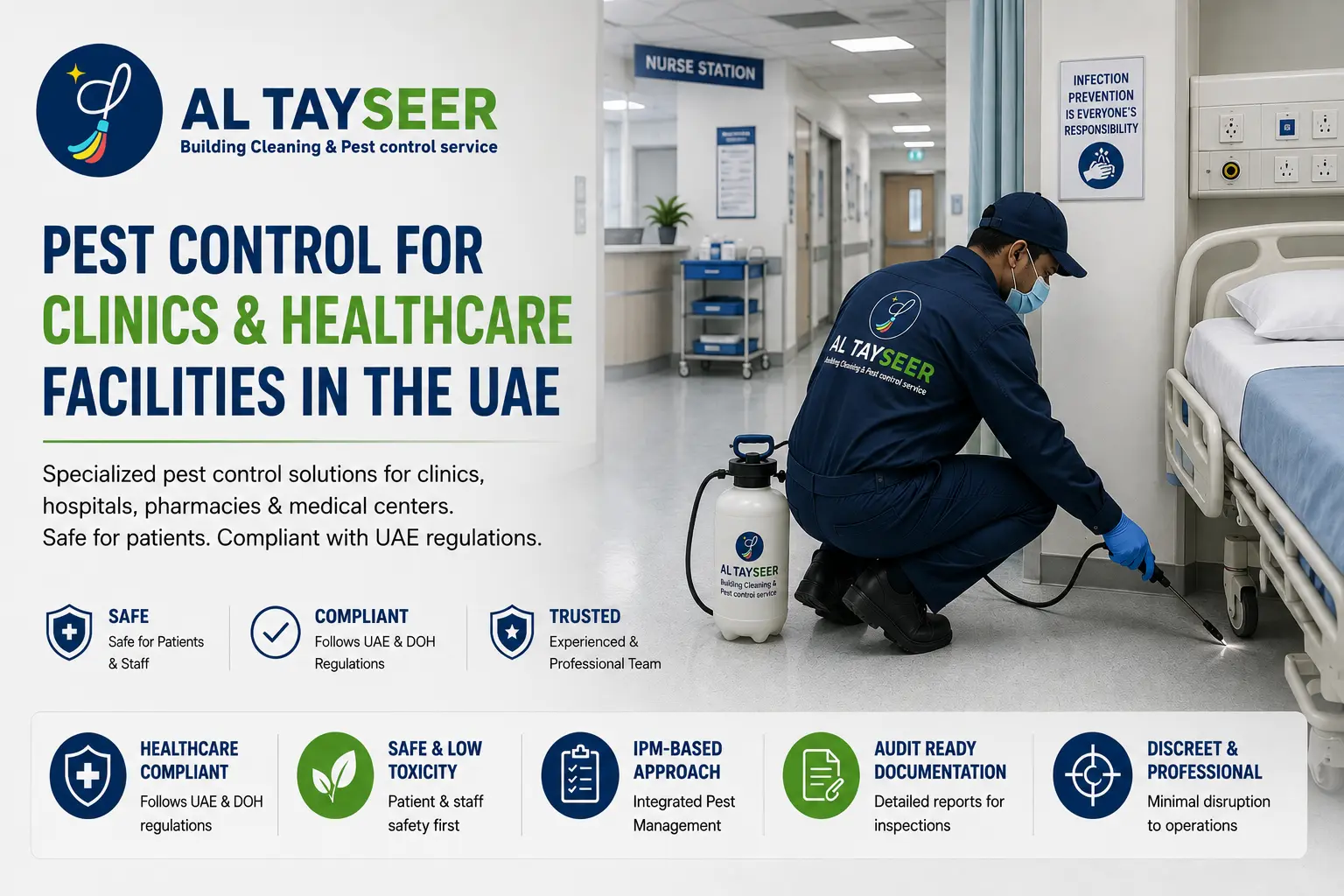
In practice, IPM in a clinic or hospital means: sealed, tamper-resistant bait stations instead of open placements; no fogging or broad-spectrum spraying in or near patient care areas; treatment scheduled around clinical hours to avoid any exposure risk; and a documented monitoring log that can be produced on request.
DOH / Municipality Compliance & Audit Documentation
For a clinic or hospital, pest control documentation is part of the same file an infection-control or facilities audit will ask for — not a separate concern. Licensed facilities across Sharjah, Ajman, and Dubai are expected to maintain continuous pest control coverage under an Annual Maintenance Contract, with records that satisfy both the municipality and any healthcare accreditation review.
- Municipality-approved service certificates issued after every scheduled visit.
- Treatment logs recording product, method, location, and technician sign-off — critical where product choice near patient areas matters.
- Monitoring station maps and inspection history, increasingly requested directly by accreditation surveyors.
- Material Safety Data Sheets (MSDS) for every product used on-site, kept on file for infection-control review.
Clinics vs Hospitals vs Pharmacies: What Changes
Clinics & Medical Centres
Lower footfall than a hospital, but treatment/procedure rooms still require low-toxicity, sealed-station methods and scheduling around appointment hours.
Hospitals
The widest range of zones under one roof — wards, kitchens, waste rooms, laundry, and pharmacy — each needing a zone-specific treatment approach and continuous monitoring.
Pharmacies & Sterile Stores
Product contamination risk is the priority. Treatment is limited to perimeter and void spaces, never near open shelving or stock, with strict documentation of anything used nearby.
Healthcare Facility Pest Prevention Checklist
| Action | Why It Matters in a Healthcare Setting |
|---|---|
| Seal and schedule waste collection promptly | Removes the top attractant for flies and rodents near clinical areas |
| Inspect kitchen and cafeteria zones weekly | Catches cockroach and ant activity before it reaches patient-facing areas |
| Log every informal pest sighting | Turns early staff reports into an actionable, trackable record |
| Keep MSDS on file for all pest control products used | Required for infection-control and accreditation review |
| Use sealed, tamper-resistant bait stations only | Prevents any product exposure risk in patient-accessible areas |
| Schedule treatment around clinical hours | Avoids disrupting patient care or appointment schedules |
When to Call a Professional
A general pest control callout isn't built for a clinical environment — it doesn't account for infection-control limits on chemical use, and it won't produce the documentation an accreditation review expects. Call a specialist if you notice recurring pest sightings in any clinical or storage area, are preparing for a DOH or accreditation audit, have a confirmed bed bug case in a patient ward, or don't currently have IPM documentation on file. A licensed inspection identifies the exact species and entry points driving the issue, using methods safe for an active healthcare environment.
Why Choose Al Tayseer
- Healthcare-Aware Treatment Protocols — Sealed bait stations and low-toxicity methods appropriate for clinics, hospitals, and pharmacies, never broad-spectrum spraying near patient areas.
- Municipality-Approved Service — Every treatment plan meets municipality requirements, with a service certificate issued after every visit.
- Documentation Built for Accreditation Review — Treatment logs, monitoring records, and MSDS sheets ready to hand over on request.
- Scheduled Around Clinical Hours — Inspections and treatment timed to avoid disrupting patient care or appointments.
- Discreet, Rapid Response — Confirmed cases such as bed bugs in patient wards are treated quickly and discreetly to prevent spread between rooms.
- 25 Years of UAE Commercial & Healthcare Experience — Facilities pest patterns across Sharjah, Ajman, and Dubai tracked by our technicians for over two decades.
Frequently Asked Questions
How often should a clinic or hospital have pest control in the UAE?
Healthcare facilities need continuous coverage under an Annual Maintenance Contract, not one-off treatments. Scheduled monitoring and inspection visits are expected to align with both municipality licensing and infection-control audit requirements.
Is pest control mandatory for clinics and hospitals in the UAE?
Yes. Licensed healthcare facilities are required to maintain documented pest control coverage as part of municipality and health authority compliance, and must be able to produce service records on request during an inspection or accreditation review.
What is Integrated Pest Management (IPM) and why does it matter for healthcare?
IPM is a pest control approach that prioritises exclusion, sanitation, and monitoring, using chemical treatment only when necessary and with methods safe for a clinical environment. Accredited healthcare facilities are typically assessed against IPM standards during infection-control and municipality reviews.
Can pest control chemicals be used safely near patients?
Yes, when handled correctly. Healthcare-appropriate pest control relies on sealed, tamper-resistant bait stations and low-toxicity products, with no fogging or broad-spectrum spraying used in or near patient care areas.
What pests are most commonly found in UAE healthcare facilities?
Flies, cockroaches, rodents, and ants account for most findings, typically concentrated around kitchens, waste rooms, and pharmacy storage. Facilities with overnight patients also carry bed bug risk tied to patient and visitor turnover.
What documentation should a clinic keep on file for pest control?
Service certificates, treatment logs, monitoring records, and MSDS sheets for every product used. These are needed for municipality compliance and are increasingly requested directly during accreditation surveys.
Can pest control be scheduled without disrupting clinic operations?
Yes. Treatment and inspections are scheduled around appointment hours and clinical activity, so patient care continues without interruption.
Book a Healthcare Facility Pest Inspection in Sharjah, Ajman, or Dubai
Don't let a pest finding become an accreditation issue. Our licensed technicians can inspect your facility, confirm what's active, and put an IPM-compliant treatment plan in place.
Call: +971 564 041 007 WhatsApp Us Now