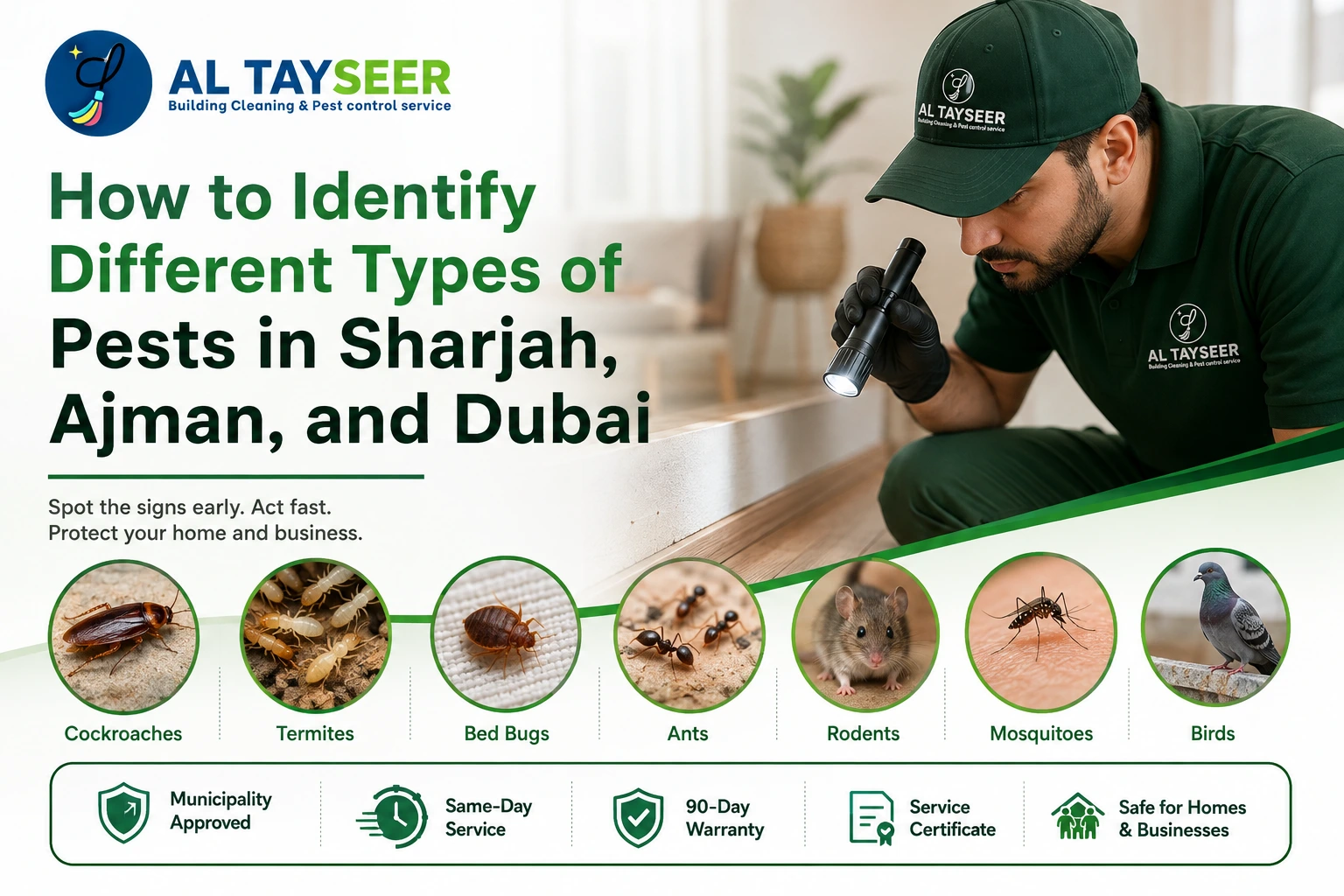
How to Identify Different Types of Pests in Sharjah, Ajman, and Dubai
Spotting a pest problem early is the single biggest factor in how easily — and how cheaply — it gets solved. In the UAE's hot, humid climate, pests don't just visit homes and businesses in Sharjah, Ajman, and Dubai — they thrive year-round, breeding faster than in most other regions. This guide walks through the most common pests found across these three emirates, the exact signs that give each one away, and what to do once you've made an identification.
Al Tayseer's technicians inspect and identify pest activity across every property type — apartments, villas, warehouses, and commercial buildings — before recommending any treatment. Correct identification is the foundation of every job we take on.
Last updated: 2026 | Reviewed by the AltPests technical pest control team
Why Pest Identification Matters Before Treatment
Misidentifying a pest is the number one reason DIY treatments fail. A spray that kills cockroaches does almost nothing to a termite colony, and bait made for ants won't touch a bed bug infestation. Professional pest control in the UAE starts with correct identification — because the treatment plan, the chemicals used, and the follow-up schedule are all pest-specific.
Sharjah, Ajman, and Dubai share a similar climate profile — high humidity, coastal proximity, and warm winters — which means the same core group of pests tends to appear across all three emirates, though with slightly different intensity depending on the neighborhood, building age, and proximity to water or vegetation.
Common Household Pests in Sharjah, Ajman, and Dubai
Seven pests account for the vast majority of reported infestations across the three emirates. Here's how to recognize each one.
1. Cockroaches
Cockroaches are the most reported pest across UAE households, and two species dominate: the American cockroach and the German cockroach.
- American cockroach: Reddish-brown, 3–5 cm long, often found in drains, basements, and sewer lines. Common in older buildings in Sharjah and parts of Ajman with aging drainage infrastructure.
- German cockroach: Smaller (1.3–1.6 cm), light brown with two dark stripes behind the head. Prefers kitchens and bathrooms — anywhere with warmth, moisture, and food residue.
Identification signs: dark, pepper-like droppings along skirting boards, a musty odor in cabinets, shed skins (exoskeletons), and egg cases (oothecae) tucked into cracks near appliances.
2. Termites
Termites cause structural damage that's often invisible until it's severe — by the time you see visible damage, the colony has usually been active for months. In villa-heavy areas of Sharjah and Ajman, subterranean termites are the dominant species, entering through soil contact with foundations.
Identification signs: mud tubes running up walls or foundations, hollow-sounding wood when tapped, discarded wings near windowsills (a sign of a recent swarm), and paint that appears bubbled or cracked without an obvious cause.
3. Bed Bugs
Bed bugs spread easily in dense residential buildings and hospitality settings, making them common in Dubai and Sharjah's high-turnover rental and hotel markets. They're small (4–5 mm), reddish-brown, oval, and flatten further after feeding.
Identification signs: small rust-colored spots on mattress seams (fecal matter), tiny blood smears on sheets, a sweet-musty odor in heavily infested rooms, and clusters of itchy, linear bite marks on skin — typically appearing in a row of three ("breakfast, lunch, dinner" pattern).
4. Ants
Ants in the UAE are less about individual sightings and more about colony size — a few ants in the kitchen usually means a colony nearby, not an isolated incident. Pharaoh ants and carpenter ants are the two most reported species.
- Pharaoh ants: Tiny (2 mm), pale yellow to red, form trailing lines to food and water sources.
- Carpenter ants: Larger (6–12 mm), black or dark red, nest in moist or damaged wood — a warning sign that overlaps with termite risk.
Identification signs: visible trailing lines, small piles of wood shavings (carpenter ants), and nests near sinks, water heaters, or irrigation lines.
5. Rodents (Rats and Mice)
Rodents are especially common near ground-floor units, warehouses, and buildings adjacent to green spaces or waste collection points across Dubai and Sharjah's older districts.
Identification signs: droppings (rice-grain shaped for mice, larger and blunt-ended for rats), gnaw marks on wiring or packaging, greasy rub marks along walls where rodents repeatedly travel, and scratching sounds in ceilings or wall cavities at night.
6. Mosquitoes
Mosquito activity spikes after rainfall or irrigation runoff, and stagnant water — even small amounts in plant trays or AC condensation trays — is almost always the root cause. Culex and Aedes species are both present across the three emirates.
Identification signs: increased bites at dawn and dusk, standing water within 50 meters of the property, and larvae ("wrigglers") visible in uncovered water containers.
7. Birds (Pigeons and Mynas)
Pigeons and common mynas are a growing concern for balconies, ledges, and rooftops in Sharjah and Ajman, where nesting sites are abundant on older low-rise buildings. Beyond noise, droppings carry health risks and can damage AC units and solar equipment.
Identification signs: accumulated droppings on balconies or window ledges, nesting material (twigs, feathers) in corners or under AC units, and repeated roosting on the same ledge at consistent times of day. For balconies and building exteriors dealing with repeat roosting, humane deterrents like bird spikes and netting are typically the most effective long-term fix — worth reading if pigeons or mynas are a recurring issue on your property.
Where You're Most Likely to Find Each Pest
| Pest | Most Common Areas | Peak Season in UAE |
|---|---|---|
| Cockroaches | Kitchens, drains, bathrooms | Year-round, worse in humidity |
| Termites | Villas, wooden structures, foundations | Spring swarming season |
| Bed Bugs | Bedrooms, hotels, furnished rentals | Year-round |
| Ants | Kitchens, gardens, near water sources | Spring and summer |
| Rodents | Warehouses, ground floors, waste areas | Cooler months (Oct–Mar) |
| Mosquitoes | Near standing water, gardens | Post-rainfall, humid months |
| Birds | Balconies, rooftops, ledges | Year-round, nesting peaks in spring |
Region-Specific Notes: Sharjah vs. Ajman vs. Dubai
Sharjah
Older residential buildings and a mix of villa communities mean termite and cockroach activity tend to run higher here than in newer developments, particularly in neighborhoods with aging plumbing.
Ajman
Coastal humidity and a high density of low-rise buildings make Ajman particularly prone to bird roosting issues and cockroach infestations tied to moisture.
Dubai
High-rise density and constant construction turnover mean bed bugs and rodents are more frequently reported in Dubai, especially in areas with high rental turnover or proximity to construction sites.
When to Call a Professional Pest Control Service
DIY methods can manage very light, early-stage infestations, but they consistently fail against established colonies — termites, bed bugs, and rodents in particular require targeted, licensed treatment. Signs it's time to call a professional include:
- Recurring sightings despite cleaning and store-bought treatments
- Any termite mud tubes or hollow-sounding wood
- Bite marks with no clear source
- Nesting evidence (rodents or birds) inside the structure itself, not just the exterior
A professional inspection typically identifies the exact species, locates the nest or colony source, and applies a treatment plan matched to that pest — rather than a generic spray that only removes what's visible on the surface.
Why Choose Al Tayseer
- 25 Years of UAE Pest Control Experience — Correct identification comes from decades of hands-on inspection across every property type in Sharjah, Ajman, and Dubai.
- Municipality-Approved Service — Every inspection and treatment plan meets municipality requirements, with a service certificate issued after every job.
- Species-Specific Treatment Plans — No generic sprays. Each treatment is matched to the exact pest identified on site.
- Same-Day Service Available — Technicians positioned across all three emirates for rapid inspection and treatment.
- 90-Day Warranty on All Treatments — If the identified pest returns within 90 days, we return at no additional charge.
- Transparent Pricing — No Hidden Costs — All quotes issued after a free inspection. See our pricing and offers page for current seasonal discounts.
Frequently Asked Questions
How do I tell the difference between a flying ant and a termite?
Flying ants have a pinched waist, bent (elbowed) antennae, and front wings longer than their back wings. Termites have a straight, thick waist, straight antennae, and wings of equal length. This is the fastest way to tell the two apart during a swarm.
Are the pests found in Dubai different from those in Sharjah or Ajman?
The core species overlap heavily since all three emirates share a similar climate, but the proportions differ — Dubai sees more bed bugs and rodents due to rental turnover, while Sharjah and Ajman see more termite and bird activity due to older building stock.
Can I identify a pest just from droppings?
Often, yes. Droppings are one of the most reliable identifiers — shape, size, and location narrow down the species significantly, even before the pest itself is spotted.
Book a Pest Inspection in Sharjah, Ajman, or Dubai Today
Not sure which pest you're dealing with? This guide is for identification purposes only — if you suspect an active infestation, our licensed technicians can confirm the species on site and recommend a treatment plan suited to your property.