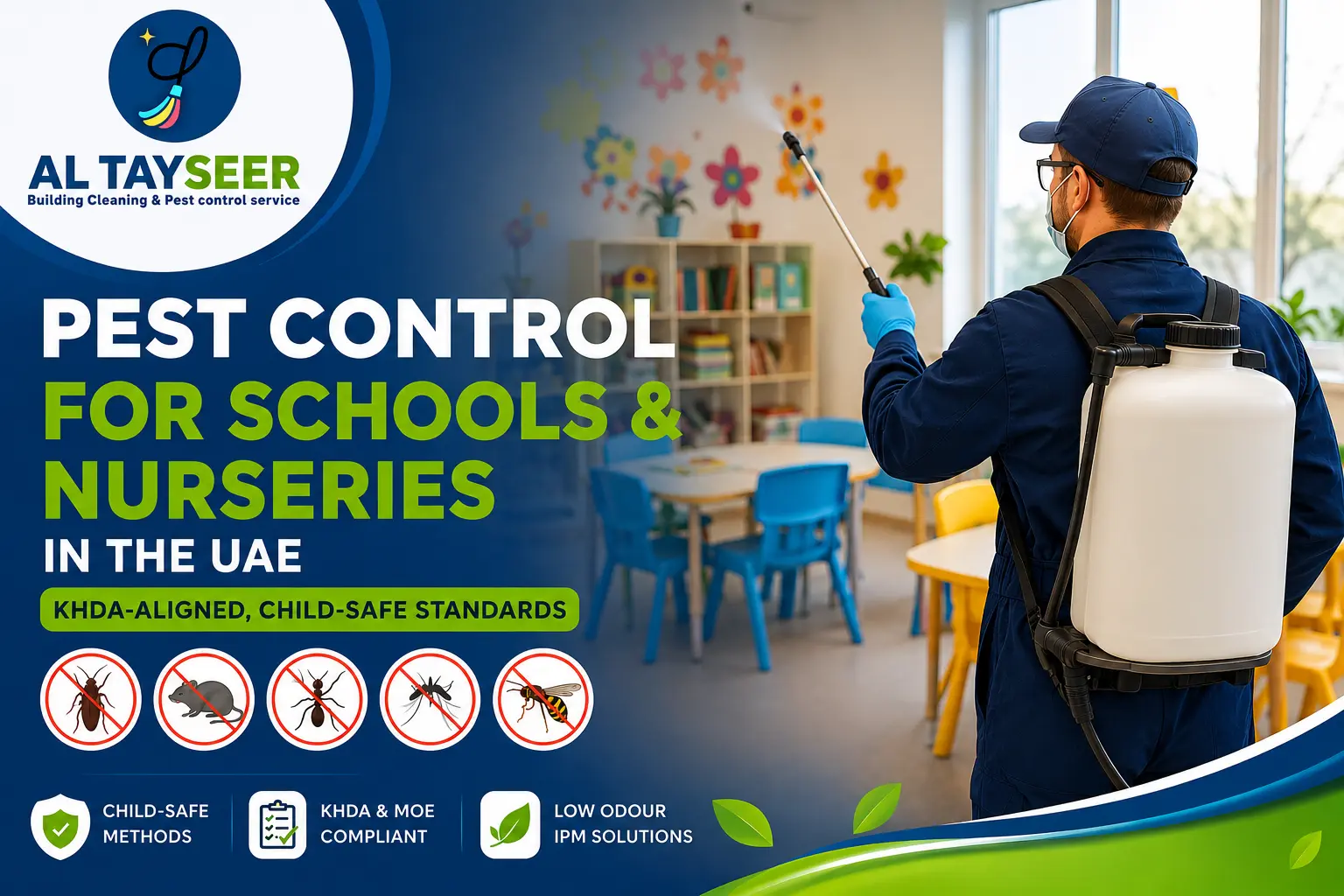
Pest Control for Schools & Nurseries in the UAE: KHDA-Aligned, Child-Safe Standards
Can a school or nursery in the UAE use normal pest control? No — not the kind used in a home or office. A nursery or school pest control programme has to work around active class hours, sleeping toddlers, and food-handling areas, which means low-odour, child-safe methods, restricted timing, and paperwork that can be shown to KHDA, ADEK, SPEA, or the Ministry of Education on request. Spraying a classroom the way you'd spray a kitchen isn't just risky — in most emirates it's a compliance failure waiting to be flagged at the next inspection.
This guide covers what changes when the site is a nursery or school, which pests cause the most inspection trouble, and the documentation an Integrated Pest Management (IPM) programme needs to produce.
Why Schools & Nurseries Need a Different Standard of Pest Control
A school can't treat a pest problem the way a warehouse or a home would — chemical exposure, patient (read: pupil) safety, and access control all limit what a technician is allowed to use and when. Children spend six to ten hours a day in the same rooms, often at floor level, and nurseries in particular have zero tolerance for aerosol or fogging treatments while kids are on-site.
This is why a compliant programme isn't just "pest control with a school logo on the van." It's a documented, low-toxicity IPM plan, timed around the academic day, with a technician trained to work in an occupied child-care environment without disrupting it.
The Pests That Put Schools & Nurseries at Risk
Every campus has a slightly different risk profile depending on age group and site size, but five pest groups account for almost every inspection flag.
1. Cockroaches
Cockroaches thrive in the warmth and moisture of school kitchens, cafeterias, and staff pantries, and a single sighting in a food-prep area is one of the fastest ways to fail a health inspection.
2. Rodents
A rodent sighting anywhere on a school or nursery site is treated as a critical finding, not a minor one — droppings in a store cupboard or classroom corner contaminate the same spaces where children eat snacks and nap.
3. Ants
Ants are drawn to any food or moisture source, and in a nursery that means snack cupboards, sensory play trays, and spilled juice under low furniture — not just the kitchen.
4. Flies
Flies are the most visible infection-control risk in any site with a cafeteria, canteen, or open waste-collection point, because a landing fly moves directly between waste, drains, and food-contact surfaces.
5. Wasps & Stinging Insects
Outdoor play areas and shaded gardens are exactly where wasps build nests, and a sting incident involving a young child is one of the most common reasons a parent escalates a complaint to management.
What Attracts Pests to a School or Nursery
Pests follow food, warmth, and moisture on a campus just like anywhere else — the difference is how many separate zones create those conditions inside one building.
- Kitchens, canteens and snack stores serving staff and pupils all day, every day.
- Sensory play and nap areas, where crumbs and spills sit at floor level, undisturbed for hours.
- Constant foot traffic through gates, drop-off zones, and playgrounds, which increases the chance of pests being carried in from outside.
- Plumbing-heavy areas — toilets sized for young children, laundry rooms, and bathrooms — that create the moisture pests need.
Warning Signs Staff Often Miss
In a school or nursery, the first sign of a pest issue is rarely reported by teaching staff — it's usually found by housekeeping or facilities teams during routine checks. Encouraging any staff member to flag early signs matters more here than in most commercial settings.
- Droppings or gnaw marks in storage, kitchen, or plant rooms.
- Unusual odours in enclosed or rarely-accessed spaces (store cupboards, under stage areas).
- Increased fly activity near waste collection points.
- Live sightings reported informally but never logged — the most common gap in early detection.
Integrated Pest Management (IPM): The Standard for Child-Occupied Sites
Accredited schools and nurseries are expected to run pest control under an Integrated Pest Management programme, not ad-hoc spraying. The U.S. Environmental Protection Agency describes school IPM as a smart, sensible, and sustainable approach that reduces children's exposure to pests and pesticides at the same time — the same logic UAE regulators apply when reviewing a facility's pest control file. IPM prioritises exclusion, sanitation, and monitoring first, with chemical treatment used only where necessary and always with a product and method appropriate for a child-occupied environment.
In practice, IPM in a school or nursery means: sealed, tamper-resistant bait placements instead of open trays; no fogging or broad-spectrum spraying while children are on-site; treatment scheduled around drop-off, nap, and pick-up times to avoid any exposure risk; and a documented monitoring log kept on file for inspection.
KHDA, ADEK & Municipality Compliance
For a nursery or school, pest control documentation sits inside the same file as every other health-and-safety record — not off to the side. Dubai's Knowledge and Human Development Authority recently set new health, safety, and quality-of-life standards for early childhood centres across the emirate as part of its approved Early Childhood Quality Framework, and facilities are expected to hold current evidence of pest control alongside cleaning, fire safety, and food-hygiene records. Ajman and Sharjah nurseries and schools are held to equivalent standards through SPEA and the relevant municipality.
What an inspector or auditor will typically ask for:
- Current service certificates issued after every visit, dated and signed by a licensed technician.
- Treatment logs recording product, method, location, and technician sign-off for every application.
- Chemical disclosure records, including Material Safety Data Sheets (MSDS) for every product used on-site.
- A written IPM plan naming a responsible contact and describing thresholds for escalation.
Nurseries vs Schools: What Changes
| Nurseries | Schools |
|---|---|
| Ground-floor premises, strict chemical restrictions, treatment only when children are off-site (weekends, after hours). | Larger campus with more zones — cafeteria, labs, sports facilities, boarding blocks where applicable. |
| Sensory and nap rooms need sealed, tamper-resistant bait only — no sprays at floor level. | Kitchen and canteen are the highest-priority zones; classrooms are inspection-only unless an issue is confirmed. |
| Parent-facing disclosure is often expected for any chemical used on-site. | Continuous term-long monitoring with a full-term summary log for facilities and compliance records. |
School & Nursery Pest Prevention Checklist
| Action | Why It Matters on a Child-Occupied Site |
|---|---|
| Seal and remove food waste from classrooms and play areas daily | Removes the top attractant for flies and rodents near where children sit and play |
| Inspect kitchen and canteen zones weekly | Catches cockroach and fly activity before it reaches food-contact surfaces |
| Log every informal pest sighting from teachers and housekeeping | Turns early, low-confidence sightings into an actionable record |
| Keep MSDS on file for every product used on-site | Required for KHDA/ADEK/SPEA and municipality inspection review |
| Schedule treatment around drop-off, nap, and pick-up times | Avoids any child exposure to product or odour during occupied hours |
When to Call a Professional
A general pest control callout isn't built for a child-occupied environment — it doesn't account for exposure limits, timing restrictions, or the documentation an accreditation review expects. Call a specialist if you notice recurring pest sightings in a classroom or kitchen, a live rodent sighting anywhere on the premises, or if the site doesn't currently have an IPM plan or treatment log on file. A licensed inspection identifies the exact species and entry points driving the issue, without exposing children to an active infestation or an unsafe treatment.
Why Choose Al Tayseer
- Child-Safe Treatment Protocols — sealed bait stations and low-toxicity methods appropriate for nurseries and schools, never broad-spectrum spraying in occupied rooms.
- KHDA/ADEK-Aligned Documentation — treatment logs, monitoring records, and MSDS sheets ready to hand over for accreditation or audit.
- Scheduled Around Class Hours — inspections and treatment timed to before/after school, weekends, and holidays to avoid disrupting learning.
- Municipality-Approved Service — every treatment plan meets Sharjah, Ajman, and Dubai municipality requirements, with a service certificate issued after every visit.
- 25 Years of UAE Commercial & Educational-Facility Experience — facilities pest patterns across Sharjah, Ajman, and Dubai tracked by our technicians for over two decades.
Frequently Asked Questions
How often should a school or nursery have pest control in the UAE?
Most nurseries and schools schedule a monthly inspection visit, with the kitchen and canteen treated as priority zones and classrooms inspected rather than routinely sprayed.
Is pest control mandatory for nurseries and schools in the UAE?
Yes — pest control documentation is part of the health-and-safety file that KHDA, ADEK, SPEA, and municipality inspectors expect to see alongside fire safety and food-hygiene records.
What is Integrated Pest Management (IPM) and why does it matter for schools?
IPM is a documented approach that prioritises exclusion and monitoring over chemical spraying, using sealed bait and treatment timed around occupied hours to avoid exposing children.
Can pest control chemicals be used safely near children?
Only low-toxicity, tamper-resistant products applied by a trained technician and scheduled outside occupied hours are considered appropriate for a child-occupied site.
What pests are most commonly found in UAE schools and nurseries?
Cockroaches and flies in kitchens and canteens, ants near snack storage, rodents in store rooms, and wasps around outdoor play areas are the most frequently reported issues.
What documentation should a school keep on file for pest control?
A current service certificate, a treatment and monitoring log, MSDS for every product used, and a written IPM plan naming a responsible contact.
Book a School or Nursery Pest Inspection in Sharjah, Ajman, or Dubai
Don't let a pest finding become an accreditation issue. Our licensed technicians can inspect your facility, confirm what's active, and put a child-safe, IPM-compliant treatment plan in place.