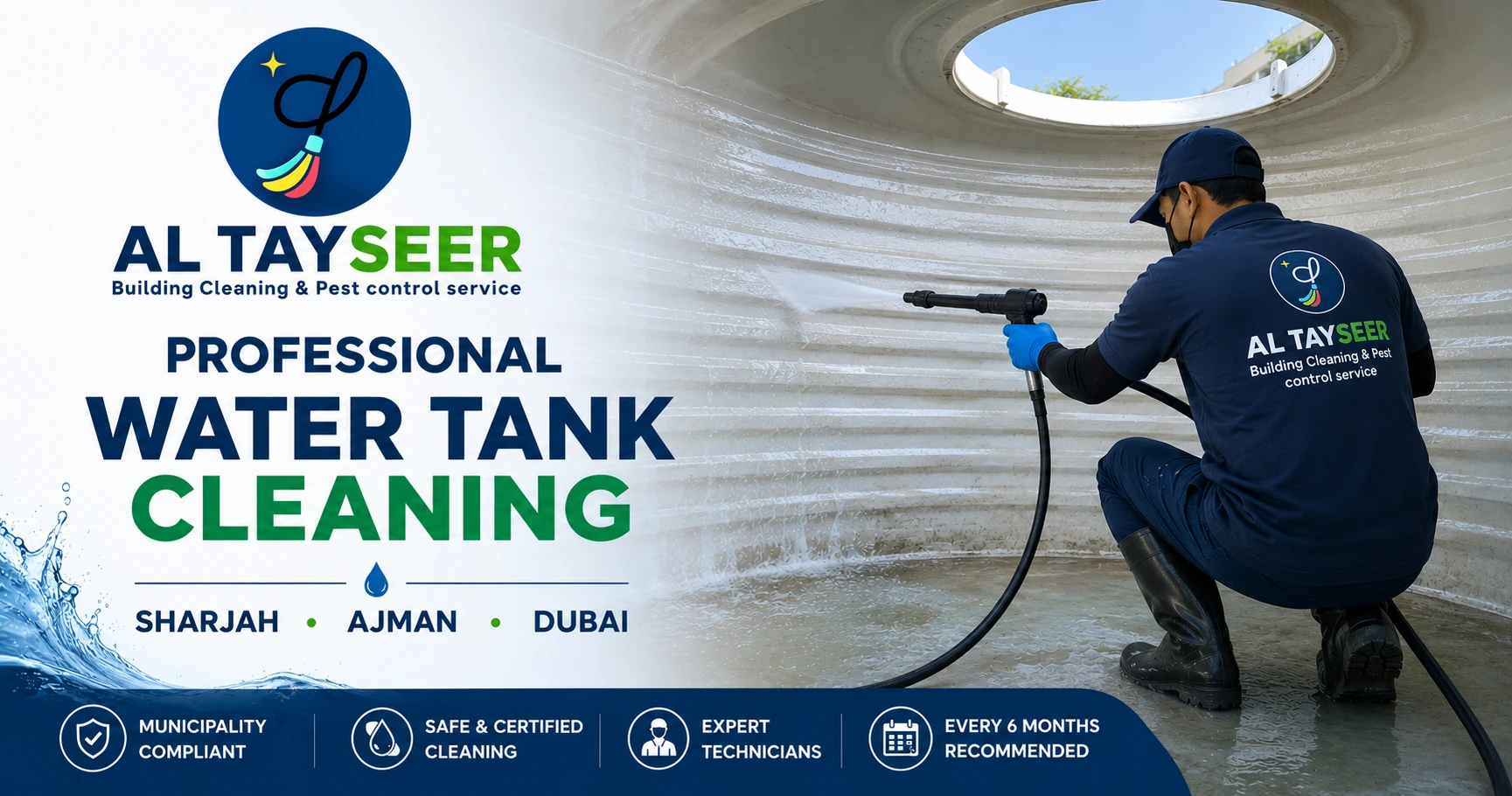
Top-Quality Water Tank Cleaning in Sharjah, Ajman & Dubai
Dubai, Sharjah, and Ajman all deliver clean, treated water to your building. What happens to it after it reaches your rooftop or underground tank is a different story — and under UAE municipality law, it's entirely your responsibility. A neglected tank is one of the most common triggers for bacterial contamination, stomach and skin illness, fines, and failed building inspections across the UAE — and none of it is visible until someone in the building gets sick or the inspector shows up.
Cracks and standing water don't stop at bacteria, either — they turn a tank into a breeding site for mosquitoes, a second health risk most residents never think to check. This guide covers exactly how often water tank cleaning in Sharjah, Ajman & Dubai is legally required, what the process involves, what it costs, and how Al Tayseer keeps tanks compliant and safe across all three emirates.
Book a Certified Tank Cleaning ? Free on-site assessment · Certificate issued same day
Why Water Tank Cleaning Matters in Sharjah, Ajman & Dubai
Heat is the problem, not the water itself. UAE summer temperatures regularly climb past 45°C, and rooftop tanks — especially the GRP (Glass Reinforced Plastic) and polyethylene tanks common across villas and older buildings — absorb that heat directly. Warm, stored water is exactly the environment bacteria, algae, and biofilm need to multiply.
Even though your incoming water arrives treated, any residual chlorine dissipates during storage, particularly in a tank that's uncovered, cracked, or overdue for a service. By the time water reaches your tap, there may be no protective barrier left at all — which is why regular water tank cleaning and disinfection exists independently of how clean your supply is when it enters the building.
What this actually means day to day: that same water is what your family drinks, cooks with, and showers in — or what a hotel and restaurant serves to guests. A contaminated tank has been linked to diarrhoea, vomiting, and skin or eye irritation from bacteria like E. coli and Salmonella, while Legionella surviving in warm stored water can cause Legionnaires' disease, a serious lung infection spread through shower mist and steam. The water can look, smell, and taste completely normal the whole time — which is exactly why municipality-approved disinfection is a legal step, not an optional extra.
Is Water Tank Cleaning Mandatory?
Yes — it's a legal requirement, not a recommendation. UAE municipalities require every residential and commercial water tank to be professionally cleaned and disinfected on a fixed schedule. Skipping a cycle can mean fines, a failed building inspection, or having your water supply flagged until compliance is restored.
Cleaning must be carried out by a licensed, municipality-approved provider, and most commercial properties are also required to test water quality afterward and keep the compliance certificate on file for inspection.
How Often Should You Clean Your Water Tank?
Every 6 months is the baseline for every property type across Sharjah, Ajman, and Dubai. Move to a 3-month cycle if your building falls into any of these categories:
- Schools, nurseries, and childcare facilities
- Hospitals, clinics, and healthcare centres
- Hotels and labour accommodation
- Restaurants, cafeterias, and food storage facilities
- Any property with unusually high water usage or heavy dust exposure
Outside of the calendar, clean immediately after any plumbing repair, tank renovation, or contamination incident — waiting for the next scheduled visit isn't safe.
The Water Tank Cleaning Process, Step by Step
What is the best method for cleaning a water tank? A proper job always follows the same sequence, whether it's a small villa tank or a large commercial one:
Inspection
Technicians check the tank's structure for cracks, sediment, or signs of pest intrusion — rodents and insects carry their own disease risk — and test the water before touching anything.
Isolation & draining
The supply is shut off and the tank fully or partially drained, depending on whether the building can go offline.
Sediment & debris removal
Sludge, rust, and organic buildup are physically removed from the base and walls.
High-pressure scrubbing
Interior surfaces are scrubbed to remove algae and biofilm that draining alone won't touch.
Disinfection
An approved, food-safe disinfectant is applied to eliminate bacteria the scrubbing can't reach.
Flush, refill & test
The tank is rinsed of chemical residue, refilled, and — for commercial properties — the water is tested before the job is signed off with a compliance certificate.
Cleaning vs. Disinfecting: Why Your Tank Needs Both
Cleaning removes what you can see; disinfecting removes what you can't. Cleaning is the physical part — draining the tank and scrubbing away sediment, rust, and algae. Disinfecting is the chemical part — applying a municipality-approved solution that kills bacteria like E. coli and Legionella that scrubbing alone leaves behind.
A tank can look spotless after a clean and still fail a water quality test if it wasn't properly disinfected, which is exactly why UAE compliance rules require both steps, every time.
Don't wait for a failed inspection to find out your tank needed both steps. Al Tayseer cleans and disinfects in the same visit, with your compliance certificate issued on the spot.
Book Your Tank Cleaning Now ?Overhead Tanks, Underground Tanks & Tanks You Can't Empty
Where your tank sits changes how it's cleaned. Overhead or "head" tanks sit on the rooftop, feeding water down by gravity — they're the most exposed to direct sun and dust, meaning faster algae growth and shorter safe intervals between cleans. Underground and ground-level tanks serve larger buildings and need confined-space equipment and separate safety protocols, since technicians work inside a sealed structure rather than an open rooftop unit.
If your building only has a single tank and can't go offline for hours, that doesn't mean cleaning gets skipped. Technicians can section off and clean in stages, arrange a temporary backup supply, or schedule the job overnight during the lowest-usage hours so residents barely notice the interruption.
Water Tank Cleaning for Apartment Buildings & Shared Properties
One tank, every unit. In an apartment building, a single rooftop or underground tank usually supplies every resident, which means one neglected tank puts the whole building at risk — not just one apartment. Building owners and management companies carry the compliance responsibility here, not individual tenants, and a lapsed cleaning schedule shows up fast during inspections tied to the building's service certificate.
Booster pump systems and shared head tanks in high-rises follow the same 6-month (or 3-month, for larger or mixed-use buildings) cycle as a standalone villa tank — the shared scale just raises the stakes.
What to Look for in a Water Tank Cleaning Company
Licensing is non-negotiable — everything else is a bonus. Before booking anyone, confirm they hold a valid municipality permit for tank cleaning; without it, the job won't count toward your compliance record no matter how good the clean looks. Beyond that, look for:
- A documented, multi-step cleaning and disinfection process — not just a quick rinse
- Municipality-approved, food-safe disinfectants
- Post-cleaning water quality testing, especially for commercial properties
- An official compliance certificate you can file or hand to your landlord or inspector
- A real track record in your specific emirate
Al Tayseer has been doing exactly this across Sharjah, Ajman, and Dubai for 25+ years, holds an active Department of Health Control and Safety license (No. 740120) and LEMS quality certification, and issues a compliance certificate after every tank cleaning visit. See our full building cleaning services for how water tank cleaning fits alongside facade, pool, and common-area maintenance.
What Does Water Tank Cleaning Cost?
It depends on your tank, not a flat rate. The biggest cost drivers are:
- Tank size and capacity
- Material — GRP, concrete, polyethylene, or sectional panels each need different handling
- Position — rooftop tanks are quicker to access than underground ones needing confined-space entry
- Whether you're booking a one-time clean or an annual maintenance contract
- Property type — commercial properties with mandatory water testing typically cost more than a standard villa tank
The only accurate way to get a number is a free on-site assessment — request a quote and Al Tayseer will size the job to your actual tank before quoting anything.
Areas We Serve
Sharjah, Ajman, and Dubai — every neighbourhood, not just the main roads. The same licensed process and compliance certificate applies wherever you're located, including:
- Al Qasimia
- Al Taawun
- Muweilah
- Al Nud
- Tilal City
- Khorfakkan
- Ajman City
- Dubai (all areas)
Frequently Asked Questions
Is water tank cleaning mandatory in Sharjah, Ajman & Dubai?
Yes, it's mandatory — not a recommendation. UAE municipalities require every residential and commercial tank to be cleaned and disinfected at least once every 6 months, dropping to 3 months for higher-risk properties, by a licensed provider.
How frequently should water tanks be cleaned?
Every 6 months at minimum. Schools, hospitals, hotels, food outlets, and heavily used or dust-exposed tanks should move to a 3-month cycle, plus an extra clean after any repair or contamination event.
What is the best method for cleaning a water tank?
A full six-step process — inspect, isolate and drain, remove sediment, scrub, disinfect, then flush, refill, and test before certifying the job.
How do you clean a large water tank that can't be emptied?
Professional teams can service it without a full shutdown — sectioning off and cleaning in stages, arranging a temporary backup supply, or scheduling overnight during the lowest-usage hours.
What's the difference between cleaning and disinfecting a water tank?
Cleaning removes physical debris; disinfecting kills what you can't see. Both steps are required for UAE compliance — one without the other isn't enough.
What are overhead (head) tank cleaning services?
Services for rooftop-mounted tanks that feed water by gravity. They're more exposed to sun and dust than underground tanks, so they typically need more frequent attention.
Who does water tank cleaning in Sharjah, Ajman & Dubai?
Al Tayseer does — licensed water tank cleaning and disinfection across all three emirates, with a compliance certificate issued after every visit.
How much does water tank cleaning cost?
It depends on the tank, not a flat number. Size, material, position, and contract type all affect the price — request a free on-site quote for an accurate figure.
What is water tank cleaning in an apartment building?
It's a shared responsibility. One tank usually feeds the whole building, so cleaning falls to the building owner or management company, tied to the property's municipality service certificate.
Which is the best water tank cleaning company in Sharjah, Ajman & Dubai?
The one that checks every compliance box — licensed, documented process, approved chemicals, water testing, and a certificate on every job. Al Tayseer has met that standard for 25+ years across all three emirates.
Book Your Water Tank Cleaning Today
Your tank's 6-month deadline doesn't wait for a convenient time. Get a municipality-compliant clean and a signed certificate the same day the job is done.
Talk to an Expert