Do Rats Carry Diseases? What Residents in Sharjah, Ajman and Dubai Need to Know
Most people know rats do not belong in the home — but most people seriously underestimate just how dangerous they are. Rats are not a nuisance that simply scurries through your kitchen at night. They are one of the most significant disease carriers in any urban environment, capable of spreading serious illness to every member of a household without ever being seen or touched. If you have noticed signs of rats in your Sharjah villa, Ajman apartment, or Dubai commercial property, the health risks are real — and they start from day one of the infestation.
1. Do Rats Actually Carry Diseases?
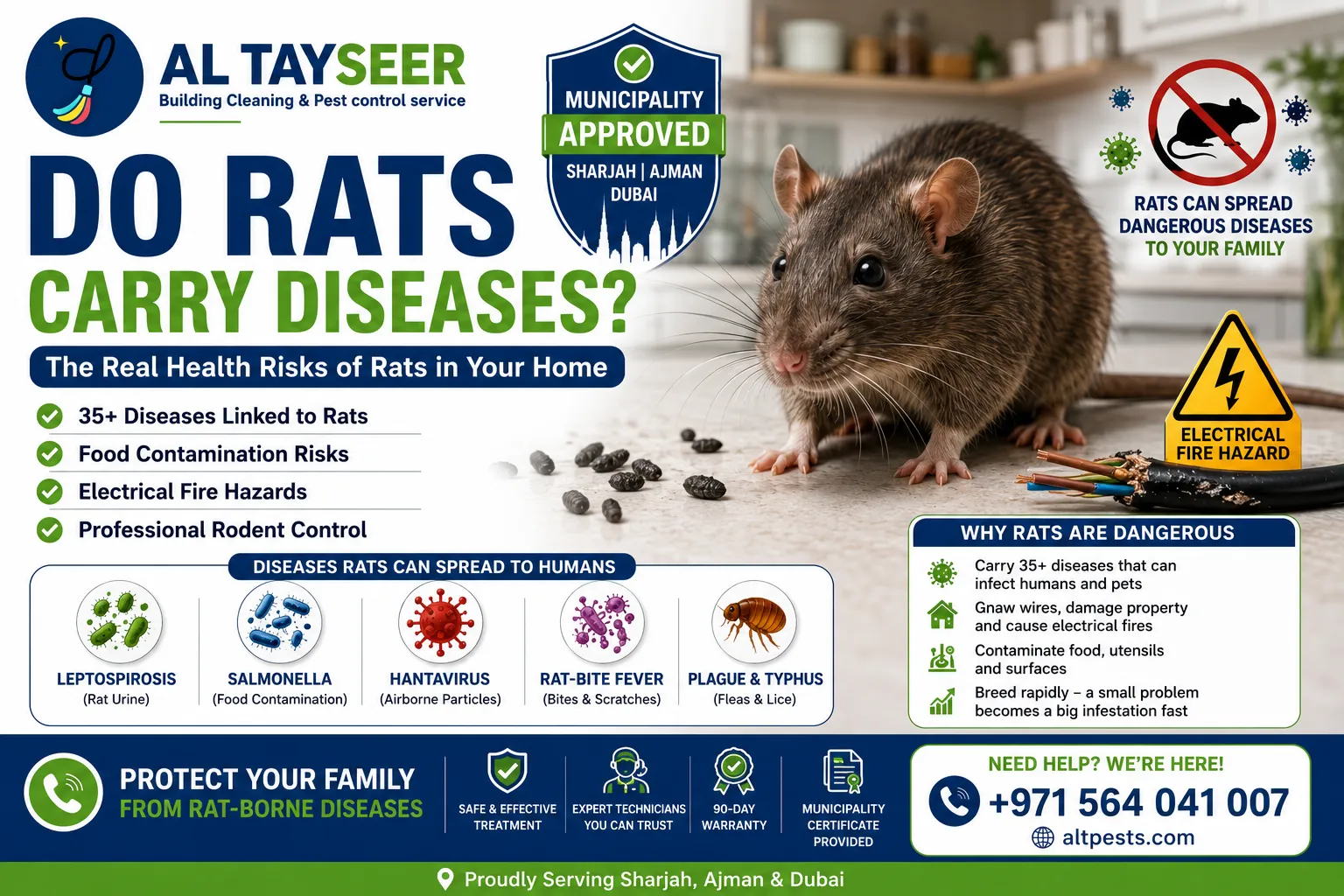
Yes — and the scale is significant. Rats are known to carry more than 35 diseases that can be transmitted directly or indirectly to humans. This is not a historical concern. It is an active public health issue in urban environments including the UAE, where high-density housing, shared drainage systems, and warm year-round temperatures create ideal conditions for rat populations to grow unchecked.
Disease transmission from rats does not require direct contact. Rats contaminate every surface they walk across, leave urine trails continuously as they move — up to 80 times per day — shed fur containing pathogens, and contaminate food and water sources simply by being present. In a shared residential building in Ajman or Dubai, a rat infestation in one unit poses a health risk to the entire floor through shared walls, drainage pipes, and common areas.
2. Which Diseases Do Rats Spread to Humans?
Rat-borne diseases fall into two groups: those spread directly through contact with rats, their urine, droppings, or saliva — and those spread indirectly through fleas, ticks, and mites that rats carry into your home. Both are a genuine concern in UAE residential and commercial properties.
The most significant diseases rats carry include:
- Leptospirosis — spread through contact with rat urine in water or on surfaces. Can progress to fatal organ failure if untreated.
- Salmonellosis — spread when rats walk across food preparation surfaces or contaminate packaging. A leading cause of food poisoning outbreaks.
- Hantavirus — spread by inhaling dust from dried rat droppings. Can cause fatal respiratory failure.
- Rat-bite fever — spread through bites, scratches, or contact with rat saliva. Causes fever, rash, and joint pain.
- Plague — spread by fleas carried on rats. Rare today but still documented globally.
- Murine typhus — spread by fleas or lice from infected rats. Causes fever, headache, and rash.
3. Leptospirosis — The Most Serious Rat Disease in UAE Urban Areas
Leptospirosis is a bacterial infection caused by Leptospira bacteria shed in rat urine. It is one of the most widespread rat-borne diseases globally and a direct concern in UAE urban environments where rats travel daily through drainage systems, basement car parks, and shared water infrastructure.
Humans contract leptospirosis through contact with water or soil contaminated by rat urine — including floodwater pooling in car parks and basements — by touching contaminated surfaces and then touching the eyes, nose, or mouth, or through open cuts coming into contact with a contaminated surface. You do not need to see a rat, touch a rat, or be bitten to contract it.
Early symptoms resemble a severe flu — high fever, intense muscle pain, and headache. In serious cases, leptospirosis progresses to Weil's disease, which causes liver failure, kidney failure, and internal bleeding. Untreated severe cases can be fatal.
4. Salmonella and Food Contamination
Rats are one of the most significant sources of salmonella contamination in residential kitchens and commercial food businesses. A rat does not need to eat your food to contaminate it. Walking across a food preparation surface transfers bacteria from their paws and fur to everything they touch. A single rat can contaminate up to ten times the food it actually consumes through droppings, urine, and fur left across kitchen shelves and inside packaging.
For restaurants, hotels, and food warehouses in Dubai and Sharjah, this is not just a health issue — it is a compliance issue. A municipality food safety inspection that finds evidence of rodent activity results in immediate closure. Commercial pest control for food businesses must be carried out by a municipality-licensed company and documented with an official treatment certificate.
5. Hantavirus — Why You Should Never Dry-Sweep Rat Droppings
Hantavirus is particularly dangerous because it requires no direct contact with a rat whatsoever. The virus is shed in rat urine, droppings, and saliva. When dried droppings are disturbed — by sweeping, vacuuming, or walking through an affected area — the virus becomes airborne. Inhaling those particles is sufficient for infection.
In severe cases, hantavirus causes Hantavirus Pulmonary Syndrome — a rapidly progressing respiratory illness with a fatality rate of up to 38%. There is no specific cure; treatment is intensive supportive care.
6. Rat-Bite Fever
Rat-bite fever is a bacterial infection transmitted through a rat bite or scratch, or through contact with rat saliva — including touching surfaces contaminated with saliva. Despite the name, a bite is not required. Symptoms appear 3 to 10 days after exposure and include fever, a distinctive rash on the hands and feet, joint pain, and vomiting.
Rat bites in the home most commonly affect young children and sleeping adults — situations where close, unguarded contact with rats is possible. If you are seeing rats during daylight hours in a Sharjah or Dubai property, the population has already grown large enough that this risk is real. Rats active during the day are a strong indicator of a large, overcrowded infestation.
7. How Dangerous Are Rats in Your Home Beyond Disease?
Disease transmission is the most serious risk from rats, but it is not the only danger. Rats in a residential or commercial property cause significant physical damage that creates independent safety hazards alongside the health risk.
Electrical fires from gnawed wiring
Rats gnaw continuously — their teeth grow throughout their lives and must be worn down by constant chewing. Electrical wiring is a frequent target. Rats chewing through live wiring is one of the most common causes of electrical fires in residential buildings across the UAE. In multi-storey Sharjah and Ajman apartment blocks, a single rat entry into ceiling spaces can damage wiring serving multiple units simultaneously.
Structural damage
Rats burrow through insulation, gnaw through wooden structural elements, damage plumbing by chewing pipe insulation and soft metal pipes, and create nesting cavities inside walls. In older Sharjah villas and Ajman properties, this damage accumulates silently over months before it becomes visible — by which point the cost of repairs far exceeds what early rodent control in Sharjah would have cost.
Rapid breeding
A female rat reaches sexual maturity at five weeks and can produce up to 12 pups per litter, with six to eight litters per year. What begins as two or three rats in a building basement can become a building-wide infestation within months — which is why early professional intervention from a rodent control specialist in Ajman or Sharjah is far more effective than waiting until the problem is severe.
8. Signs You Have Rats in Your Property
Rats are nocturnal and deliberately avoid open spaces, which means most infestations are well established before residents see a visible rat. These are the signs to watch for:
- Droppings — dark, capsule-shaped, 10 to 20mm long, found along walls, inside cabinets, behind appliances, and in food storage areas
- Gnaw marks — on food packaging, wiring, wooden furniture, skirting boards, and pipe insulation
- Scratching sounds — inside walls, above false ceilings, or under flooring, most active between midnight and 4 AM
- Grease marks — dark smear marks along walls and skirting boards where rats repeatedly travel the same route
- Nesting material — shredded paper, fabric, or insulation found in quiet corners, under sinks, or behind large appliances
- Rat burrows — holes in garden soil, under paving, or at the base of walls — common in Sharjah and Ajman villa properties
- Ammonia smell — a sharp, persistent odour from urine accumulation in nesting areas
9. When to Call a Professional in Sharjah, Ajman or Dubai
If you are finding droppings, hearing scratching at night, or have seen a rat — even once — it is time for a professional inspection, not a trip to the hardware store. Rats are intelligent and cautious. They quickly learn to avoid traps and bait stations placed by someone unfamiliar with their movement routes. Effective rodent control requires identifying all entry points, locating every nesting site inside the structure, and applying a combination of trapping, baiting, and permanent exclusion that stops re-entry.
Store-bought bait and snap traps rarely resolve an established infestation. They eliminate the visible rats while leaving entry points open and the remaining population — which is always larger than what you have seen — to continue breeding. The infestation returns within weeks.
Al Tayseer provides rodent control across Sharjah, Ajman, and Dubai with municipality-approved treatments, full entry-point inspection, and a 90-day warranty on every visit. For residential buildings and villa compounds, a yearly pest control contract covers rodents alongside cockroaches, bed bugs, and other pests under a single scheduled programme — the most cost-effective way to maintain a pest-free property long term.
Noticed droppings, gnaw marks, or scratching sounds in your property? Municipality-approved rodent control for homes and businesses across Sharjah, Ajman and Dubai. 90-day warranty on every treatment.
Book Rodent Control Now Residential Services10. FAQs — Do Rats Carry Diseases?
Yes. Rats carry over 35 diseases transmissible to humans, including leptospirosis, salmonellosis, hantavirus, and rat-bite fever. A bite is not required — contact with urine, droppings, or contaminated surfaces is sufficient for several of these illnesses.
Rats are a serious health and structural risk. Beyond disease, they gnaw through electrical wiring — a leading cause of house fires — damage plumbing and walls, contaminate food supplies, and breed rapidly. A small problem becomes a significant infestation within weeks if not treated professionally.
Yes. Most rat-borne diseases do not require a bite. Leptospirosis spreads through contact with rat urine on surfaces. Salmonella transfers when rats walk across food preparation areas. Hantavirus can spread by inhaling dust from dried droppings. Sharing a living space with rats is itself a health risk.
Dark capsule-shaped droppings along walls and in cabinets, gnaw marks on wiring or packaging, scratching sounds inside walls at night, greasy smear marks along skirting boards, a persistent ammonia smell, and visible burrows near foundations or garden walls.
Never dry-sweep rat droppings — the dust can carry hantavirus. Wet them thoroughly with disinfectant, leave for five minutes, then remove carefully with gloves and dispose in a sealed bag. For a property with a confirmed infestation, professional sanitation after treatment is recommended.
Yes. Sharjah Municipality, Ajman Municipality, and Dubai Municipality all require pest control including rodent control for commercial premises and food businesses. Al Tayseer is fully municipality-approved and issues the required treatment certificates after every visit.
Both rats and mice carry diseases, but rats — particularly the Norway rat and roof rat common in UAE urban areas — are associated with a wider range of serious illnesses including leptospirosis and hantavirus. Rats also produce more urine and droppings per day, creating greater surface contamination across an affected property.
Cost depends on property size, infestation severity, and whether entry-point sealing is required. Contact Al Tayseer for a free site assessment and quote — pricing is provided per treatment with no hidden charges, and the treatment certificate is included in the cost.