What Are Drain Flies? How to Get Rid of Them in Sharjah, Ajman & Dubai
You close the bathroom at night and return in the morning to find dozens of tiny, fuzzy flies hovering around the sink or shower drain. They don't move fast. They don't seem to bite. But they reappear every single day — no matter how much you clean. These are drain flies — and in UAE bathrooms, kitchens, and utility rooms, they are one of the most persistent nuisance pests residents encounter. This guide explains exactly what drain flies are, why UAE properties are particularly vulnerable, and how to eliminate them permanently.
1. What Are Drain Flies?
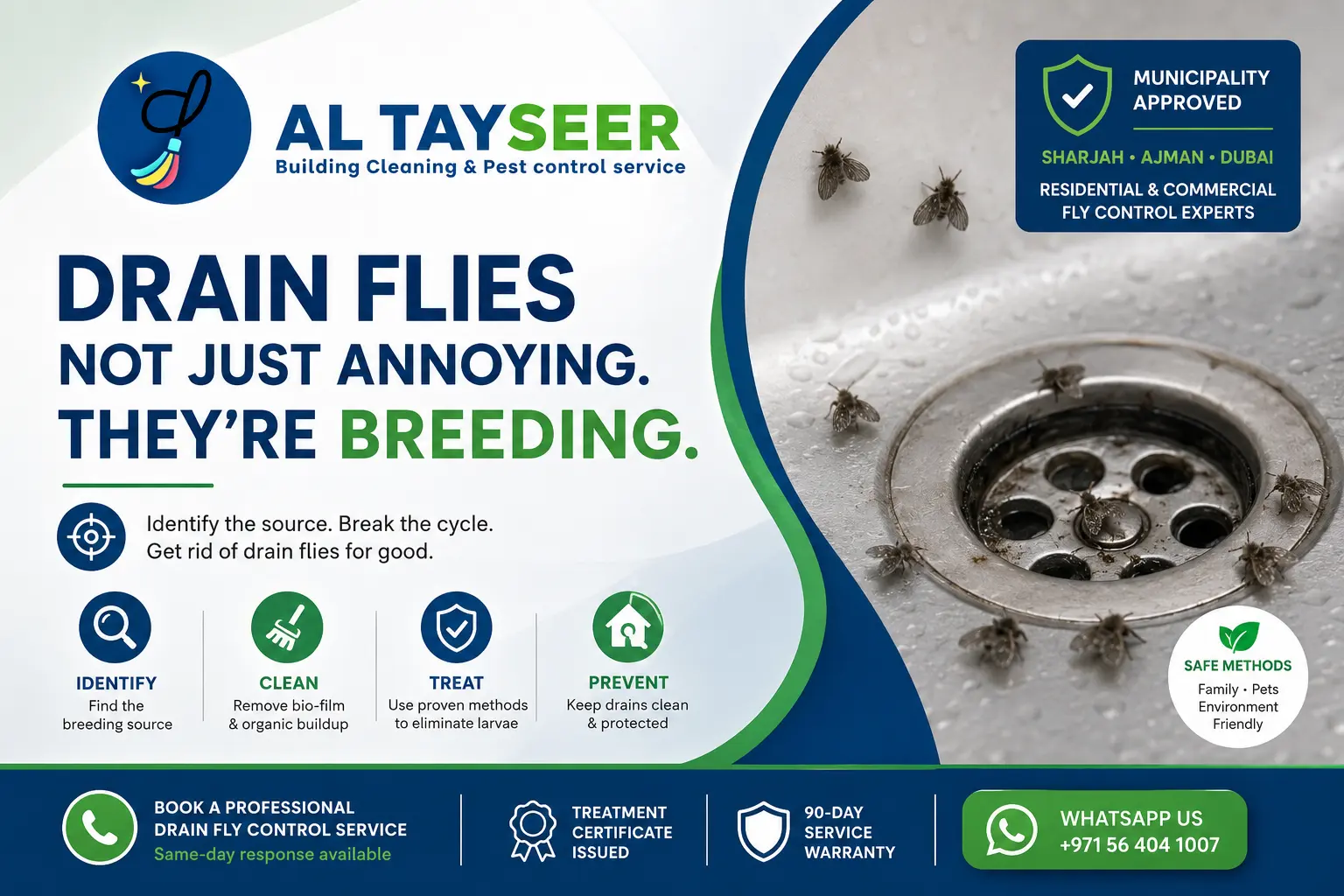
Drain flies — also called moth flies, sewer flies, or filter flies — are small flying insects that breed inside the organic matter that accumulates inside slow-moving or stagnant drains. They belong to the family Psychodidae and are found in bathrooms, kitchens, laundry rooms, and anywhere with a damp, bio-film-coated drain. Unlike mosquitoes or house flies, they do not travel far from their breeding site — which is why you almost always find them clustered directly above the drain they came from.
Drain flies are not a sign of poor hygiene. They are a sign of organic matter build-up inside a drain — something that happens naturally over time in any household and extremely quickly in UAE conditions, where the heat accelerates biological decomposition inside pipes. A perfectly clean bathroom can develop a drain fly problem simply from an unused floor drain or a slow-draining shower.
2. What Do Drain Flies Look Like?
Drain flies are small and distinctive once you know what to look for. They are often mistaken for fruit flies or fungus gnats, but their appearance and behaviour are quite different.
| Feature | Description |
|---|---|
| Size | 1.5 – 5 mm — roughly the size of a sesame seed |
| Colour | Grey to light brown; covered in fine, dense hairs giving a moth-like appearance |
| Wings | Large, ovoid, moth-like wings that fold flat over the body at rest — key identification feature |
| Movement | Short, jerky hops rather than sustained flight — rarely travel more than one metre from the drain |
| Antennae | Long, clearly segmented, and visible to the naked eye |
| Activity | Most active at dusk and overnight; rest on walls near drains during daylight hours |
| Lifespan | Adults live 8–24 days; larvae develop in 9–15 days in UAE temperatures |
3. Where Do Drain Flies Come From?
Drain flies breed exclusively in the gelatinous bio-film that coats the interior of drains, pipes, and drain traps. This film is composed of decomposing organic material — soap residue, hair, food particles, skin cells, and bacteria. Female drain flies lay 10 to 200 eggs inside this film, and larvae hatch and complete their development entirely within the pipe before emerging as adult flies at the drain surface.
In UAE properties, the most common breeding sites are:
The single most common source — particularly in apartments and villas where the drain is not used every day and the water trap dries out, removing the barrier to gas and insect movement.
Soap scum, hair, and skin cells create ideal bio-film conditions that build up in weeks in the UAE's warm temperatures.
Food grease and organic waste decompose rapidly in warm conditions, producing a rich bio-film inside the trap and pipe bend that drain flies readily colonise.
A frequently overlooked source. Every UAE air conditioner produces condensate water that drains through a pipe — warm, always damp, and rarely cleaned. Blockages accumulate bio-film extremely quickly.
The overflow hole in sinks and bathtubs is rarely cleaned and stays permanently damp — an ideal low-traffic breeding site that is easily missed during routine cleaning.
Stagnant water in rarely used floor drains — common in Sharjah and Ajman villa basement utility rooms — creates ideal breeding conditions that can sustain large drain fly populations for months.
4. Why Drain Flies Are So Common in UAE Properties
The UAE's climate creates conditions where drain fly populations grow faster and are harder to eliminate than in cooler regions. Three factors drive this:
Year-Round Heat Accelerates Breeding
Drain fly larvae develop in 9 to 15 days in temperate climates. In the UAE's 30–45°C summer temperatures, development inside a warm drain pipe completes in as few as 7 days. A drain fly population that would take weeks to establish elsewhere can reach significant numbers within days during UAE summer. This is why a minor drain fly presence can become a visible infestation extremely rapidly if the breeding source is not addressed immediately.
Shared Drainage Systems in Multi-Storey Buildings
Sharjah, Ajman, and Dubai apartment buildings use shared vertical drainage risers connecting multiple floors. A drain fly problem originating on one floor — from a neglected floor drain in a vacant unit, for example — can spread breeding populations through the shared riser to adjacent units and floors above. Residents may find drain flies emerging from drains that appear perfectly clean, because the active breeding source is several floors below in the shared pipe.
Universal Air Conditioning Produces Condensate Everywhere
Every property in the UAE runs air conditioning for most of the year, and every AC unit produces condensate water that requires drainage. These condensate lines are warm, constantly damp, and typically run through wall cavities where they are never inspected. Partial blockages in condensate lines create standing water and bio-film accumulation — producing ideal drain fly breeding conditions in locations that are invisible to residents and not addressed by normal drain cleaning.
5. Are Drain Flies Harmful?
Drain flies are primarily a nuisance pest. They do not bite, they do not sting, and they are not known to directly spread disease to humans through contact. However, they are not entirely harmless:
- Contamination of food surfaces: Drain flies emerge from drains carrying bacteria present in the bio-film — including E. coli, Salmonella, and Listeria in kitchen environments. When they land on food preparation surfaces, utensils, or uncovered food, they transfer these bacteria. This makes drain flies a genuine food hygiene concern in any property where food is prepared, and a compliance risk for commercial kitchens across Sharjah, Ajman, and Dubai.
- Asthma and allergy triggers: The shed larval skins (exuviae) of drain fly larvae can become airborne and trigger asthma attacks and allergic reactions in sensitive individuals — a documented health effect recognised by the World Health Organization and particularly relevant in UAE apartments with recycled air conditioning systems.
- Municipality compliance risk for businesses: Evidence of drain flies during a municipality food safety inspection of a restaurant, hotel kitchen, catering facility, or food warehouse constitutes a violation that can result in immediate operational suspension. Fly control is a legal requirement for commercial food businesses in Sharjah, Ajman, and Dubai — and self-treatment does not satisfy that requirement.
6. How to Get Rid of Drain Flies — Step by Step
Eliminating drain flies requires removing the breeding environment — not just killing the adult flies you can see. Adult flies killed with a spray are replaced by new adults emerging from the drain within days. Permanent elimination requires physically cleaning the bio-film out of the pipe itself.
Identify Every Breeding Drain
Before treating, confirm every active breeding source using the tape test described above. Check every drain — including AC condensate outlets, utility room floor drains, bathroom overflow holes, and balcony drains. Treating only one drain when multiple are active will not resolve the problem.
Remove the Bio-Film Mechanically
Use a drain brush or flexible bottle brush to physically scrub the inside of the drain pipe and trap, removing the bio-film layer where eggs and larvae live. Follow with a kettle of boiling water to flush loosened material. This mechanical step is essential — simply pouring boiling water down an uncleaned drain does not reach the film coating the pipe walls.
Apply a Biological Enzyme Drain Cleaner
After mechanical cleaning, apply a biological enzyme drain cleaner — available in most Sharjah and Dubai hardware stores — that breaks down organic matter continuously over 7 to 14 days. Avoid chemical drain cleaners (bleach, caustic soda) at this stage: they kill surface larvae on contact but dissolve rather than remove the bio-film, and leave a temporarily sterilised environment that recolonises within days once the chemical disperses.
Pour Mineral Oil Into the Trap
After the enzyme treatment, pour a small amount of mineral or vegetable oil into the drain. The oil coats the water surface inside the trap, suffocating any remaining larvae and preventing adult flies from laying new eggs on the water surface — a simple and effective supplementary step for bathroom floor drains.
Prevent Re-Infestation
- Run water through all floor drains at least twice a week — dry drain traps are the leading cause of drain fly recurrence in UAE properties
- Clean kitchen sink drains with a brush and enzyme cleaner weekly
- Check and flush AC condensate drain lines every 3 months
- In vacant rooms or properties, seal floor drains with drain plugs when not in use
- Fix any slow-draining pipes immediately — standing water inside a slow drain accelerates bio-film formation dramatically in UAE temperatures
7. What Professionals Use for Drain Fly Elimination
When drain fly infestations persist despite thorough DIY cleaning, or when they appear in commercial premises where self-treatment is insufficient for compliance purposes, professional treatment offers capabilities that are not available to residents.
High-Pressure Drain Jetting
Professional drain jetting uses high-pressure water to remove bio-film from pipe walls at every depth and bend — reaching sections that a drain brush cannot access. For building basement drains, grease traps, and commercial kitchen drain systems with months of accumulated grease and organic waste, jetting is the only method that reliably clears the bio-film layer completely from an entire pipe run.
Insect Growth Regulators (IGRs) for Drainage Systems
Municipality-approved IGR treatments are poured or injected directly into the drain system and disrupt the drain fly reproductive cycle at larval stage — preventing larvae from maturing into adult flies for 30 to 60 days. This breaks the breeding cycle while the bio-film is being addressed, eliminating the gap where adult flies continue emerging during the cleaning process. Our fumigation and IGR services include drain-targeted formulations for both residential and commercial drainage systems.
UV Light Traps for Commercial Premises
For restaurants, hotels, and food preparation facilities across Dubai and Sharjah, professional UV light traps provide continuous capture of adult drain flies and other flying insects, protecting food preparation areas while the breeding source is simultaneously being treated. UV traps are a municipality-recommended component of commercial fly control programmes and provide the documented ongoing pest management that food business inspections require.
8. When to Call a Professional in Sharjah, Ajman or Dubai
DIY drain fly treatment resolves the majority of residential infestations when carried out correctly and consistently. Professional intervention is required when:
- Drain flies return within days of thorough cleaning — indicating a breeding source the cleaning is not reaching, such as a broken underground pipe, a deeply blocked condensate line, or a shared building drain riser
- Drain flies are present in a commercial premises, restaurant, or food business — self-treatment does not satisfy municipality food safety requirements in Sharjah, Ajman, or Dubai
- Multiple drains across different rooms or floors of a building are affected simultaneously — indicating a shared drainage infrastructure issue requiring building-level inspection
- Drain flies are appearing from walls or ceilings with no visible drain — indicating a broken underground or in-wall pipe where bio-film has accumulated inside a wall or floor void
For a broader overview of flying pest problems in UAE properties, see our detailed guide on how to get rid of house flies, which covers the identification and elimination of the most common fly species found in UAE homes and commercial properties.
Drain Flies Returning Despite Cleaning?
Municipality-approved fly control and drain treatment across Sharjah, Ajman & Dubai. Same-day response available. Treatment certificate issued after every commercial visit. 90-day warranty on residential treatments.