Scorpions in Sharjah, Ajman & Dubai: Danger Signs, Prevention & Removal
Scorpions have always lived in the desert around Sharjah, Ajman, and Dubai — but as new communities push further into that terrain, they're turning up in gardens, garages, and occasionally inside villas more often than most residents expect. Most stings are painful rather than dangerous, but knowing which species you're actually dealing with, what draws them indoors, and when one sighting means a bigger problem is what keeps a household safe.
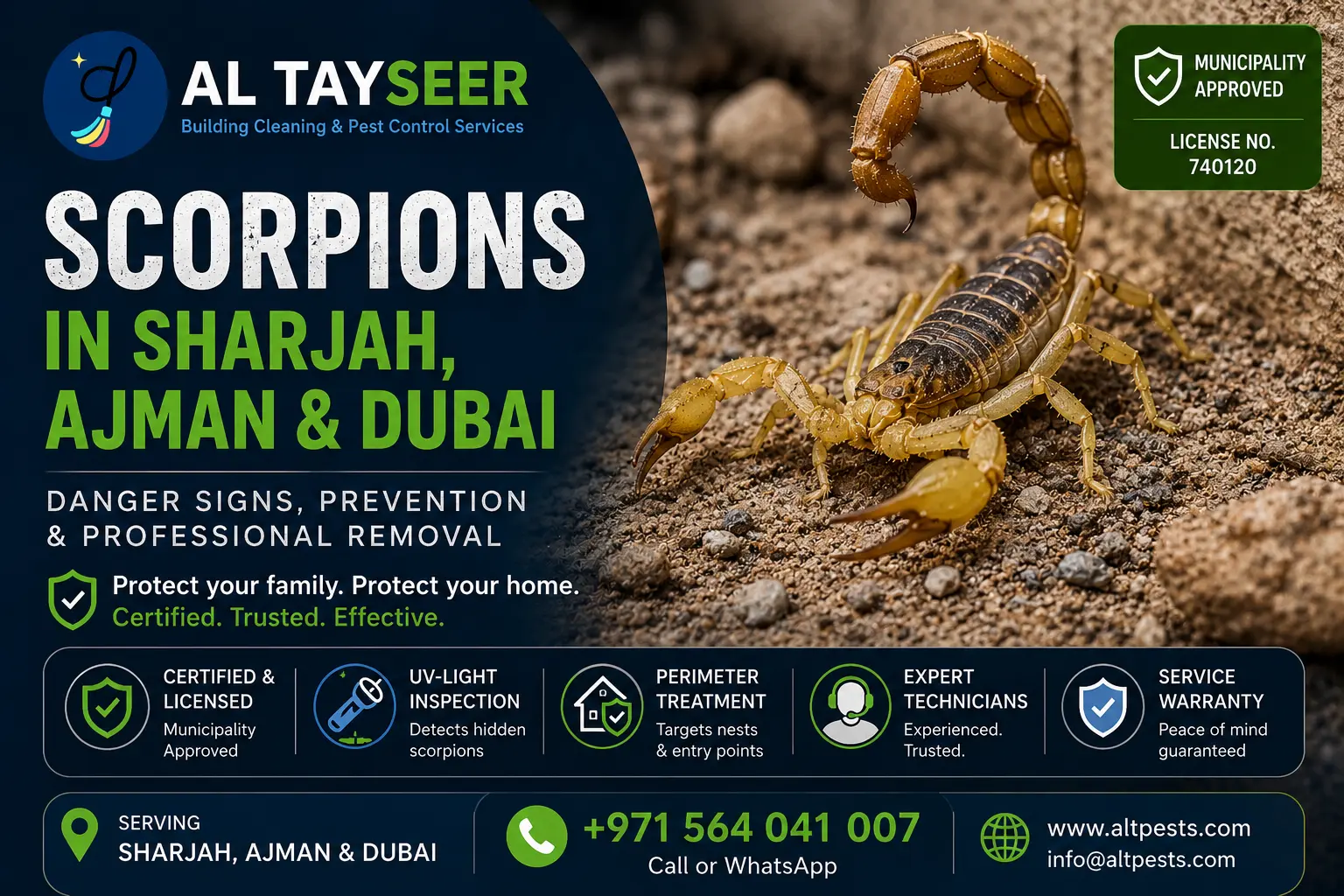
Two species account for almost every serious case in the region: the Arabian fat-tailed scorpion, whose venom is potent enough to need medical attention, and the smaller, yellow deathstalker. Telling them apart in the dark isn't something to attempt yourself — that's exactly what Al Tayseer's scorpion pest control services are built for.
Book a Certified Scorpion Inspection → UV-light detection · Municipality-approved · Warranty included
Are Scorpions in Sharjah, Ajman & Dubai Actually Dangerous?
For a healthy adult, most scorpion stings in the UAE are intensely painful but not life-threatening — the real risk concentrates around a couple of specific species and a handful of vulnerable groups, not scorpions in general.
The Arabian fat-tailed scorpion (Androctonus crassicauda) is the one to take seriously — dark in colour, found throughout the region, and carrying venom potent enough to require medical attention. The smaller, yellow deathstalker delivers a sting that's often reported as more painful but tends to cause fewer serious complications. Either way, the people most at risk are children, the elderly, and anyone with a known allergy, for whom even a routine-looking sting can trigger a severe allergic reaction.
What Attracts Scorpions to Your Home or Garden?
Scorpions don't wander onto a property at random — they follow moisture, food, and shelter, roughly in that order.
- Standing moisture: leaking AC units, dripping taps, and over-watered garden beds give a desert creature exactly what it's short of in the wild.
- A food source: crickets, cockroaches, and other insects are what scorpions actually hunt, so an active cockroach problem is often the real reason they've moved in.
- Cluttered hiding spots: firewood piles, stacked planters, garden debris, and anything left flat against an exterior wall.
- Unsealed entry points: gaps under doors, cracks in boundary walls, and unscreened drains all double as a front door.
Warning Signs You Have a Scorpion Problem, Not Just a Visitor
One scorpion almost never means one scorpion — females can produce dozens of young in a single brood, so a single sighting is usually evidence of more, not the whole story.
- Repeated sightings in the same room or area, rather than a one-off in the garden.
- Shed exoskeletons in corners, storerooms, or under furniture — scorpions moult several times as they grow.
- A noticeable uptick in crickets, roaches, or other small insects, which is what's feeding them.
- Finding one somewhere it had to actively travel to reach, like a shoe, bathtub, or laundry basket, rather than just outside a door.
How to Scorpion-Proof Your Home
A few structural fixes do more long-term good than any spray you can buy over the counter.
Seal entry points
Caulk cracks in exterior walls, weather-strip doors and windows, and seal around pipe penetrations and AC units.
Clear hiding spots
Move firewood, stacked pots, and garden debris away from the foundation and exterior walls.
Fix moisture sources
Repair leaking taps, AC condensation lines, and irrigation drippers that create standing water.
Trim landscaping
Keep grass short and branches clear of the building so nothing bridges the ground to a window or balcony.
Store items off the floor
Shake out shoes, gloves, and anything left on a garage or storeroom floor overnight.
Schedule a perimeter treatment
A licensed scorpion control technician treats the cracks and nesting areas a spray bottle can't reach, often alongside general residential pest control to close off entry points for everything else too.
What to Do If Someone Is Stung
Stay calm and clean the area first — most healthy adults recover from a scorpion sting with rest and over-the-counter pain relief, but a few situations always warrant a hospital visit.
Go straight to a hospital or call for emergency help if: the person stung is a young child, elderly, or has a known allergy; there's swelling of the face or throat, or difficulty breathing; or symptoms include muscle twitching, heavy sweating, or numbness spreading beyond the sting site.
For everyone else: wash the area with soap and water, apply a cold compress to ease swelling, keep the affected limb still, and monitor for a few hours. Avoid home remedies like cutting the skin or trying to suck out venom — UAE wildlife experts specifically warn against both, since they raise the risk of infection without doing anything for the sting itself.
Do Scorpions Really Glow Under UV Light?
Yes — scorpions carry a compound in their exoskeleton that reacts to ultraviolet light, causing them to glow a bright blue-green in the dark.
That's why a proper inspection is done at night with a UV blacklight rather than a normal torch in daylight — it reveals scorpions hiding in wall cracks, garden beds, and gaps that would otherwise go completely unnoticed, even ones too small or well-hidden to spot with the naked eye. It's the first step in Al Tayseer's scorpion inspection process.
Can Scorpions Get Into Apartments or Upper Floors?
Rarely under their own power — scorpions are ground-dwellers that don't climb multiple storeys on their own, which is why villas, ground-floor units, and properties backing onto open desert see the most activity.
That said, they can hitch a ride into a higher floor inside a delivery box, a plant pot, or luggage brought back from a desert trip, and older buildings with gaps around risers or drainage lines can still see the occasional indoor sighting on any floor. If it happens once, treat it the same as a ground-floor sighting — worth an inspection, not just a one-off wipe-down.
When Are Scorpions Most Active in the UAE?
Scorpions are nocturnal year-round, but their activity climbs sharply as temperatures rise from spring into summer.
Cooler winter months largely keep them dormant underground; as the weather warms, they come out to hunt at night in far greater numbers. That's why a preventative treatment ahead of the season does more good than waiting for the first sighting to act.
When to Call a Professional Scorpion Control Team
A can of spray from the hardware store treats what's visible today, not what's breeding under the garden wall.
DIY treatments knock down what you can see on the surface but rarely reach nesting sites, don't identify which species you're actually dealing with, and don't touch the food source keeping them fed. A proper visit combines UV-light inspection, targeted perimeter treatment, and food-source control in a single pass — worth booking if you've had more than one sighting, have young children, elderly residents, or pets at home, or your property backs onto open land or a construction site.
Al Tayseer provides certified scorpion pest control services in Sharjah, with the same standard covering Ajman and Dubai under a single warranty.
Areas We Serve
Sharjah, Ajman, and Dubai — from the older neighbourhoods to the newest developments pushing into the desert.
Frequently Asked Questions
Are scorpions in Sharjah, Ajman & Dubai dangerous?
Most stings are painful rather than life-threatening for healthy adults. The Arabian fat-tailed scorpion and the deathstalker — the two most medically significant species in the UAE — can cause serious reactions, especially in children, the elderly, or anyone with an allergy.
What is the most dangerous scorpion species in the UAE?
The Arabian fat-tailed scorpion (Androctonus crassicauda). It's considered the most medically significant species in the region. The smaller yellow deathstalker causes an extremely painful sting but fewer serious complications.
What attracts scorpions to a home or garden?
Moisture, food, and shelter. Leaking water sources, a crickets-or-cockroach food supply, and cluttered hiding spots like firewood or garden debris are the biggest draws.
What should I do if someone is stung by a scorpion?
Clean the area and apply a cold compress, then go straight to a hospital if the person stung is a young child, elderly, or shows signs of an allergic reaction. Avoid home remedies like cutting the skin or trying to suck out venom.
Do scorpions attack people on purpose?
No. Scorpions avoid humans and only sting in self-defence, typically when accidentally touched, stepped on, or trapped inside clothing or shoes.
Do scorpions really glow under UV light?
Yes. A compound in their exoskeleton fluoresces bright blue-green under ultraviolet light, which is why professional inspections happen at night with a UV blacklight.
Can scorpions get into apartments or upper floors?
Rarely on their own, since scorpions are ground-dwellers, but they can be carried in through deliveries, plants, or luggage, and older buildings can still see occasional indoor sightings on any floor.
When are scorpions most active in the UAE?
Nocturnal year-round, but far more active as temperatures rise from spring into summer — which is why preventative treatment ahead of the season works better than reacting to a sighting.
Do scorpions bite as well as sting?
No. Scorpions don't bite — they grip with their pincers and deliver venom only through the stinger at the end of their tail.
Who do I call for scorpion control in Sharjah, Ajman & Dubai?
Al Tayseer — municipality-approved scorpion inspection and treatment across all three emirates, using UV-light detection and a service warranty.
Don't Wait for the Next Sighting
One scorpion is rarely the whole story. Get a certified inspection before summer activity peaks, not after.
Book a Scorpion Inspection