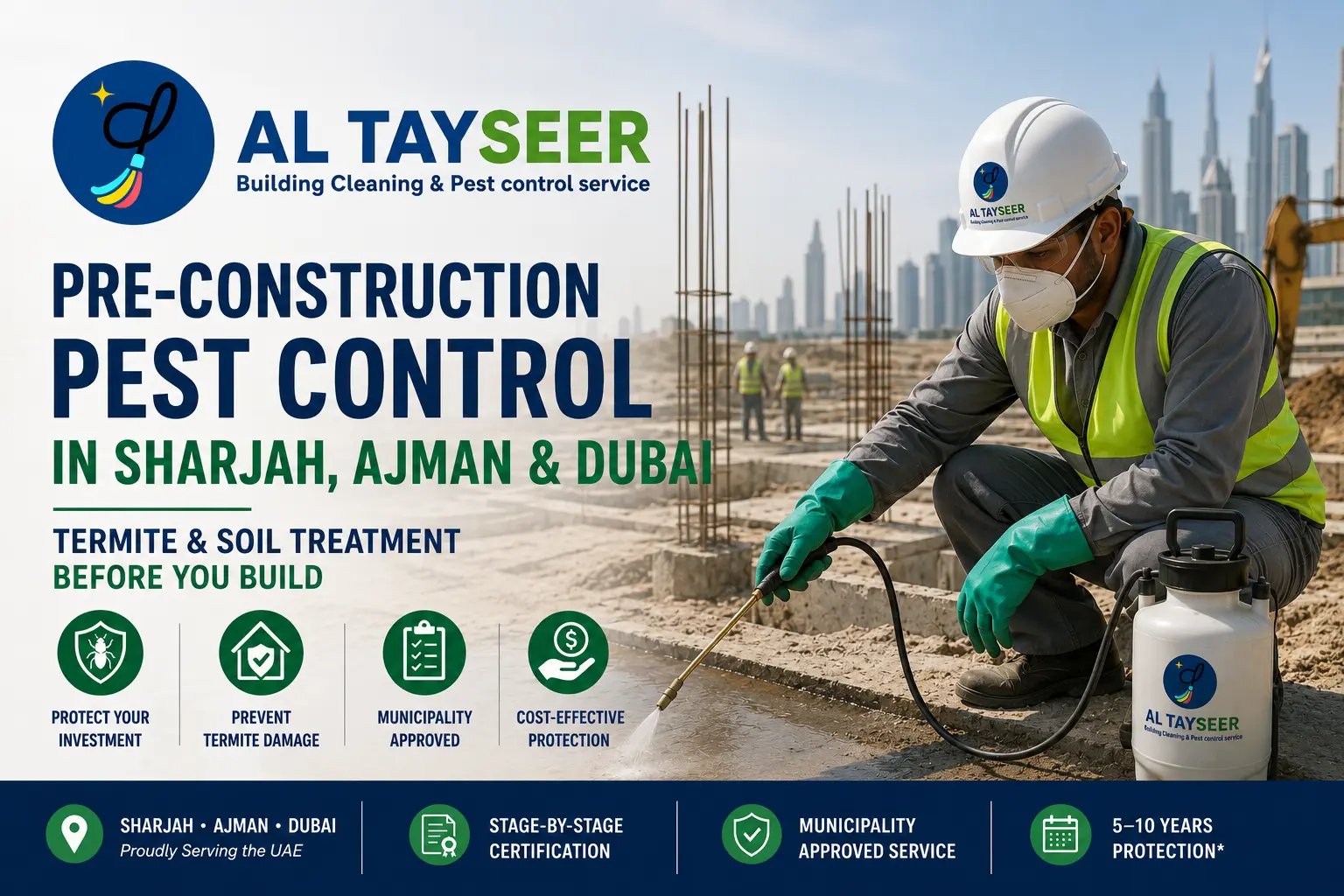
Pre-Construction Pest Control in UAE — Termite & Soil Treatment Before You Build
Building a new villa, residential complex, or commercial facility in the UAE is a significant investment. What most property developers and homeowners do not realise until it is too late is that the soil beneath any UAE construction site contains one of the most destructive forces a building will ever face: subterranean termites. Pre-construction pest control is the process of treating the soil and structural elements of a building before construction is completed — creating a protective chemical barrier that prevents termites and other soil-borne pests from entering the structure for years after handover. Once a building is complete, the same level of protection costs significantly more and is dramatically less effective. This guide explains what pre-construction pest control involves, when it is legally required in the UAE, and why it is the most cost-effective pest investment you will ever make on a new build.
1. What Is Pre-Construction Pest Control?
Pre-construction pest control — also called pre-construction termite treatment or soil treatment — is a systematic chemical and physical barrier programme applied to the ground, foundations, and structural elements of a building at specific stages of the construction process, before the structure is enclosed and the floors are laid.
Unlike post-construction pest control treatments that must work around finished walls, flooring, and furniture, pre-construction treatment is applied directly to bare soil, foundation trenches, concrete slab undersides, and wall cavities while they are fully accessible. This allows the creation of a continuous, unbroken chemical barrier between the soil and the building structure — something that is physically impossible to achieve once construction is complete.
Pre-construction treatment primarily targets subterranean termites — the most destructive and most active pest species in UAE soil — but also addresses cockroaches, ants, and other soil-borne pests that commonly enter new buildings through foundation joints, service penetrations, and floor slab cracks.
2. Why Pre-Construction Treatment Is Critical in the UAE
The UAE presents uniquely severe conditions for termite activity compared to most other regions. Three factors make pre-construction termite treatment not just advisable, but essential for any new build in Sharjah, Ajman, Dubai, or Abu Dhabi:
Subterranean Termite Activity Is Extremely High in UAE Soil
The Gulf Subterranean Termite (Anacanthotermes vagans) and the Indian Subterranean Termite (Odontotermes obesus) are the primary species found across UAE construction sites. Both are highly aggressive, operate in very large colonies of hundreds of thousands to millions of individuals, and are active year-round in the UAE's warm soil. Termite colonies in UAE desert and sandy soil have been found at depths of 3 to 4 metres — meaning they are present beneath virtually every construction site in the region, regardless of visible signs at surface level.
Construction Methods Create Natural Entry Points
Standard UAE construction — concrete slab foundations, block cavity walls, and service penetrations for electrical and plumbing — creates multiple natural entry points for subterranean termites. Termites enter through the smallest gaps: expansion joints in concrete slabs, the interface between foundation walls and floor slabs, pipe and cable penetrations, and settlement cracks that develop after construction. Pre-construction soil treatment creates a chemical barrier that prevents entry at these points before they exist.
Cost of Remediation After Construction Is Many Times Higher
Pre-construction soil treatment applied during construction costs a fraction of what termite remediation costs once a building is infested. Post-construction termite treatment requires drilling through floor tiles and finished concrete to inject termiticide, injecting into wall cavities, removing and reinstating finished surfaces, and treating structural timber where damage has occurred. In established infestations, structural repair costs alone can far exceed the original building's pest treatment budget.
3. Which Pests Does Pre-Construction Treatment Target?
While subterranean termites are the primary target, pre-construction pest treatment addresses the full range of soil-borne and foundation-entry pests common across UAE construction sites:
The primary target. Gulf and Indian Subterranean Termites cause extensive structural damage to timber, insulation, and even non-cellulose materials in UAE buildings. Treated with soil termiticide and physical barriers.
Common in Sharjah and Ajman soil. Ants enter through foundation cracks and slab joints, establishing colonies inside wall cavities and under flooring shortly after construction completes.
Subterranean cockroaches enter new buildings through drainage connections, floor drain penetrations, and slab cracks. Pre-construction drain barrier treatment prevents entry through these routes.
Particularly relevant for construction sites in Sharjah inland areas and desert-adjacent locations. Scorpions enter new builds through foundation gaps and are most active in the first year after construction as disturbed soil settles.
For existing termite activity already detected in or around a construction site, see our termite control services in Sharjah for pre-treatment inspection and active colony management before the pre-construction chemical programme begins.
4. The Four Stages of Pre-Construction Pest Treatment
Pre-construction termite and pest treatment is not a single application — it is a multi-stage programme applied at specific points in the construction timeline. Each stage addresses a different vulnerability that will no longer be accessible once the build progresses. Missing any stage compromises the integrity of the entire barrier.
The first application treats the cleared, levelled soil before any foundation digging, concrete work, or shuttering begins. A liquid termiticide — typically bifenthrin or imidacloprid — is applied to the entire building footprint at a rate of 5 litres per square metre to a depth of 30 cm, creating a uniform toxic soil zone from the lowest structural point upward. This is the most important single treatment stage and cannot be retroactively replicated once the foundation is poured.
As foundation trenches are excavated for footings and column bases, the exposed trench walls and bottom are treated with termiticide before concrete is poured. The backfill soil around the completed foundations is also treated as it is replaced, creating a treated soil envelope around every foundation element. Junction points between foundation walls and floor slab areas receive concentrated application to seal the most vulnerable termite entry points.
Before the ground floor concrete slab is poured, the compacted hardcore layer directly beneath the slab is treated with termiticide and a physical termite barrier membrane is laid. All expansion joint locations, service pipe penetrations, and column base junctions are specifically sealed and treated — as these represent the primary termite entry routes through a completed slab. Some specifications include a physical stainless steel mesh barrier at slab edges, required by certain municipality specifications for high-risk sites.
The final stage is applied after external works are complete — around the building perimeter, beneath paved walkways adjacent to foundations, and along the interface between the building structure and exterior landscaping. This treatment renews and extends the outer edge of the chemical barrier and is applied as a follow-up to the in-construction stages. It is also the stage that connects pre-construction treatment to the building's ongoing yearly pest control contract for long-term protection.
5. Is Pre-Construction Pest Control Mandatory in UAE?
Yes — pre-construction termite treatment is a mandatory requirement for new construction under the building regulations of all major UAE municipalities.
- Sharjah Municipality: Requires documented pre-construction soil treatment for all new residential and commercial buildings. The treatment must be conducted by a Sharjah Municipality-approved pest control company and a treatment certificate must be submitted to the municipality as part of the building completion documentation.
- Dubai Municipality: Specifies pre-construction termite treatment as a requirement under its building construction code. Dubai Municipality requires the use of approved termiticide formulations and mandates that treatment is inspected and certified before the building certificate of occupancy is issued.
- Ajman Municipality: Requires pre-construction soil treatment certification from a licensed pest control company as part of the building permit documentation process for new residential and commercial construction.
6. Pre-Construction vs Post-Construction Treatment — Key Differences
Understanding the differences between pre-construction and post-construction treatment explains why pre-construction treatment is the only truly effective approach for new buildings:
| Factor | Pre-Construction Treatment | Post-Construction Treatment |
|---|---|---|
| Access to soil | Full access — direct soil treatment at all depths | Limited — must drill through completed floors and walls |
| Chemical barrier | Continuous, unbroken barrier possible | Gaps inevitable at inaccessible structural points |
| Disruption | None — applied during construction | Significant — drilling, dust, temporary floor damage |
| Cost | Low — soil application to bare ground | High — specialist drilling, material reinstatement |
| Effectiveness | Maximum — barrier applied before entry points exist | Moderate — barrier applied after entry points are sealed in |
| Municipality requirement | Mandatory — certificate required for occupancy | Not a certificate requirement; only used as remediation |
| Treatment lifespan | 5–10 years depending on termiticide used | 3–7 years; shorter in high-activity soil |
| Structural damage prevented | Yes — barrier prevents entry before damage begins | No — treatment applied after damage has already occurred |
7. What Happens If You Skip Pre-Construction Treatment?
Buildings constructed without proper pre-construction pest treatment in the UAE regularly exhibit termite damage within two to five years of completion. The consequences of skipping this stage are serious on multiple levels:
- Termite damage to non-structural elements: Beyond structural timber, termites consume insulation, dry-lining backing boards, wooden skirting boards, door frames, furniture, and stored cellulose materials — all of which are replacement costs borne by the property owner.
- Post-construction treatment cost: Remediating an established termite infestation in a completed building typically costs three to seven times more than the original pre-construction treatment would have cost, due to the labour required to drill through finished floors, inject into wall cavities, and reinstate damaged finishes.
- Municipality compliance failure: A building completed without a pre-construction treatment certificate cannot obtain its occupancy permit. Attempting to proceed without the certificate, or submitting a falsified certificate, constitutes a serious regulatory violation.
- Insurance implications: Many property insurance policies in the UAE exclude termite damage from coverage, or reduce claim payments where it is demonstrated that no pre-construction treatment was carried out. This exposes the property owner to the full cost of both remediation and structural repair.
8. When to Schedule Your Pre-Construction Treatment
Pre-construction treatment requires coordination with the project construction programme. The key dates to plan around are:
- Stage 1 treatment should be booked immediately after the site is cleared and levelled — before any mechanical digging begins. This is often the treatment stage most easily missed when construction timelines accelerate.
- Stage 2 treatment must be scheduled to coincide with the foundation excavation timeline — treatment must be applied while trenches are open, before concrete is poured.
- Stage 3 treatment is scheduled before the ground floor slab pour — usually during the period when hardcore is being laid and services are being roughed in beneath the slab.
- Stage 4 treatment is scheduled after external works are complete, as part of the building handover and completion documentation process.
Al Tayseer's commercial pest control team works directly with contractors and project managers to coordinate treatment timing with the construction programme. We issue stage-by-stage treatment certificates suitable for municipality submission, and provide a single handover document covering all four stages at building completion — ready for inclusion in the occupancy permit application.
For completed new buildings entering their first year of occupation, a residential pest control service plan or a yearly pest control contract should be established to complement the pre-construction barrier with ongoing perimeter monitoring, inspection, and preventive treatment as the chemical barrier approaches renewal.
Starting a New Build in Sharjah, Ajman or Dubai?
Municipality-approved pre-construction pest treatment with stage-by-stage certification for occupancy permit submission. Coordinated to your construction programme timeline. Treatment certificates issued after every stage.