Commercial & Industrial Pest Control · Sharjah · Ajman · Dubai
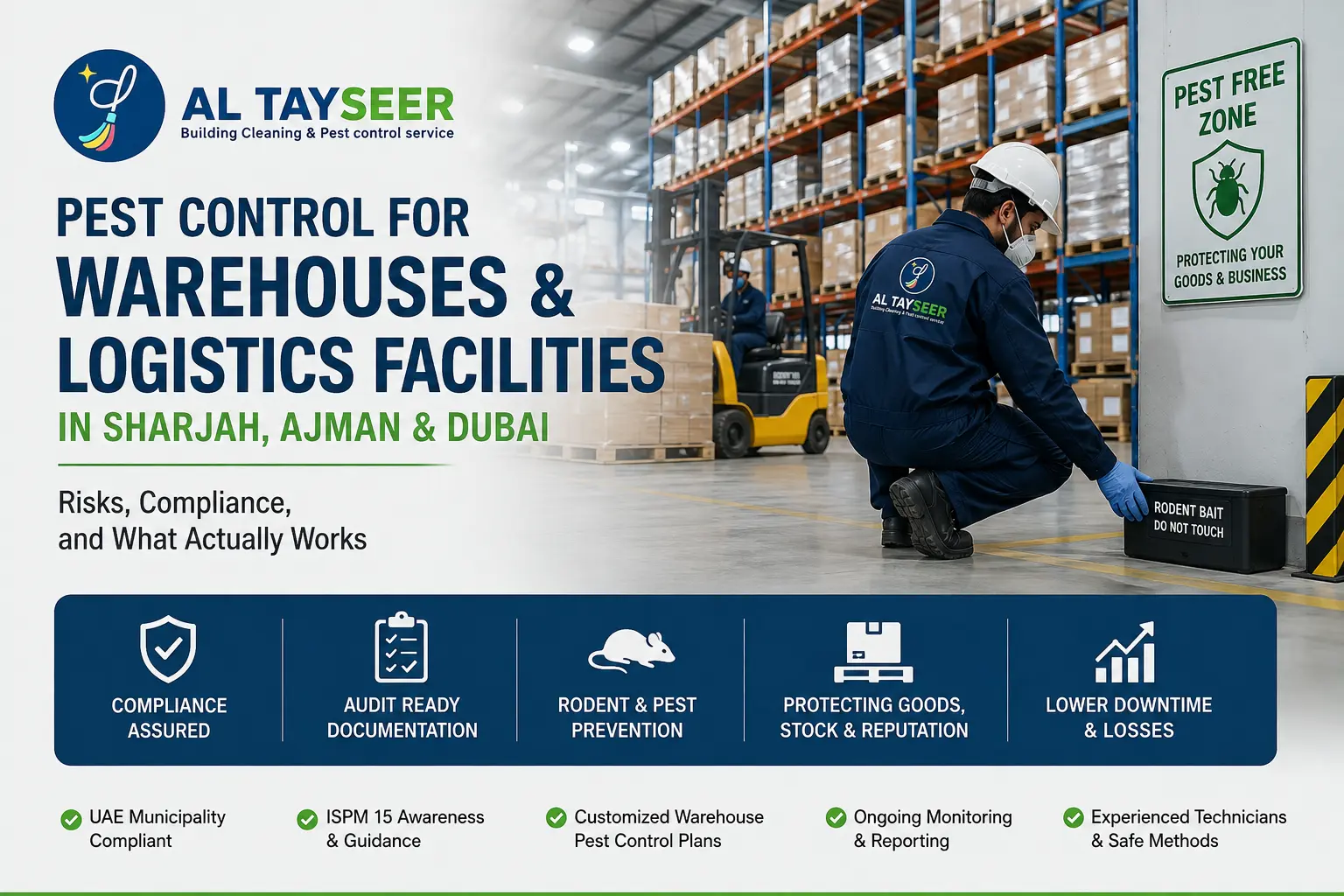
Pest Control for Warehouses & Logistics Facilities in Sharjah, Ajman & Dubai: Risks, Compliance, and What Actually Works
Every warehouse audit failure or held shipment across Sharjah, Ajman, and Dubai traces back to the same handful of causes — and most aren't visible on the floor until it's too late. A single rodent bite through the wrong cable can shut down a warehouse management system for a full shift, and a non-compliant wooden pallet can hold an entire shipment at customs. This guide covers what actually goes into pest control for a warehouse or logistics facility — the pests specific to bulk storage, the ISPM 15 requirement most operators only hear about after a problem, and the documentation a municipality inspector or client audit will ask to see.
Why Warehouses & Logistics Facilities Are High-Risk for Pests
Facilities that go unmonitored between scheduled visits often only see the first visible sign of a problem once it's already spread — a gnaw mark, a dropping trail, or a failed inspection. Catching it during a routine AMC visit is far cheaper than treating an infestation a client or municipality audit has already flagged.
The 5 Risks That Spike Hardest in Warehouses & Logistics Hubs
These five account for almost every pest-related compliance issue and operational loss across warehouses and distribution centres in the UAE.
1. Rodents
Rodents are the single most costly pest in a warehouse, and dense pallet storage gives them exactly the undisturbed shelter they need to breed. A rat or mouse colony can chew through cabling, packaging, and even structural insulation long before staff spot one in daylight.
2. Cockroaches
Cockroaches cluster around loading docks, break rooms, and any warmth or moisture source — and in food-grade logistics, a single sighting during a client walkthrough can end a contract. Break-room kitchenettes and poorly sealed waste points are the most common entry route.
3. Stored-Product Pests
Weevils, flour beetles, and moths spread through dry goods storage fast — often introduced in a single contaminated pallet and capable of infesting an entire storage bay within weeks. These are the pests most likely to trigger a rejected shipment or a failed food-safety audit, not the ones staff notice first.
4. Termites
Wherever wooden pallets, crates, or racking sit against a concrete floor for extended periods, termites become a structural risk that goes unnoticed for months. Damage is often only found once racking or flooring is already compromised.
5. Birds
Pigeons and mynas nesting in high racking, mezzanine steel, or open dock canopies create a droppings-and-debris hazard directly above stored goods. This is one of the most common findings during industrial bird control inspections and one of the least monitored risks on a warehouse floor.
The Loading Dock Connection: A Warehouse's Biggest Overlooked Trigger
ISPM 15, Wood Pallets & the Import/Export Pest Risk
If your facility handles imported or exported goods on wooden pallets, ISPM 15 compliance determines whether your shipment clears customs at all. The international standard requires wooden packaging to be heat-treated or fumigated and stamped with an official mark before crossing a border, specifically to stop wood-boring pests travelling between countries inside pallets and crates. A non-compliant pallet can mean a shipment held at port or a rejected consignment — a risk that sits with the logistics operator, not the supplier.
Sharjah Industrial Area vs Port Khalid vs Free Zone Facilities
Sharjah Industrial Area
Factories and warehouses see the sharpest rodent and stored-product pest activity, driven by dense pallet storage and high dock turnover.
Port Khalid
Container and bulk cargo handling raise the wood-packaging and fumigation risk — ISPM 15 compliance matters most here.
Al Hamriyah Free Zone
Mixed industrial, office, and residential accommodation on one site means rodent and cockroach pressure from every direction.
Warehouse Pest Prevention Checklist
| Action | Why It Matters in a Warehouse |
|---|---|
| Close dock doors between loads | Removes the largest single entry point for rodents and flying insects |
| Rotate stock (first-in-first-out) | Prevents undisturbed pallet zones where pests establish unnoticed |
| Seal gaps around dock seals and utility penetrations | Blocks the main routes pests use to enter a climate-controlled building |
| Report damaged packaging immediately | Spilled or torn product is the top food source driving activity |
| Keep monitoring station logs current | Turns a reactive callout into an audit-ready compliance record |
| Renew ISPM 15 documentation for wood packaging | Prevents shipments being held or rejected at customs |
When to Call a Professional
A DIY trap or an over-the-counter spray treats what's visible on the floor today — it doesn't map a 5,000 sqm facility or produce the paperwork a municipality inspector will ask for. Call a professional if you notice recurring rodent or insect sightings, are due for a municipality licence renewal, handle imported wood packaging without current ISPM 15 documentation, or are preparing for a client or food-safety audit. A licensed inspection identifies the exact species and entry points driving the infestation — not just the pests visible on the surface.
Why Choose Al Tayseer
- 25 Years of UAE Industrial Experience — Warehouse and logistics pest patterns across Sharjah, Ajman, and Dubai are something our technicians have tracked for over two decades.
- Municipality-Approved Service — Every treatment plan meets municipality requirements, with a service certificate issued after every visit.
- ISPM 15 Certification On-Site — Wood packaging compliance handled alongside general pest control, through a single provider.
- Zone-Based Monitoring Programs — Rodent and insect stations mapped across your full floor plan, not blanket treatment.
- Scheduled Around Your Operations — Inspections and treatment timed to shift patterns and dock activity, with minimal disruption.
- Audit-Ready Documentation — Treatment logs, service certificates, and monitoring records ready to hand over for any client or municipality audit.
Frequently Asked Questions
How often should a warehouse in the UAE have pest control?
Most warehouses need an ongoing Annual Maintenance Contract, not a one-off treatment. Sharjah, Ajman, and Dubai municipalities generally expect industrial facilities to maintain continuous coverage, with scheduled inspections rather than reactive callouts, to stay compliant for licence renewal.
Is pest control mandatory for warehouses in Sharjah?
Yes, for most industrial and commercial facilities. An Annual Maintenance Contract is typically required by the municipality to maintain trade licence compliance, and facilities are expected to produce service documentation on request during inspections or audits.
What is ISPM 15 and does my warehouse need it?
ISPM 15 is the international standard requiring wooden pallets and packaging to be treated and stamped before crossing a border. Any facility handling imported or exported goods on wood packaging needs ISPM 15-compliant materials, or shipments risk being held or rejected at customs.
What pests cause the most damage in warehouses?
Rodents cause the most costly damage — chewing through wiring, cabling, and stored goods packaging — followed by stored-product insects like weevils and moths, which can spread through an entire storage bay from a single contaminated pallet.
Can pest control be done without stopping warehouse operations?
Yes. Treatment and inspections are scheduled around shift patterns and dock activity, typically during off-peak hours, so loading, storage, and dispatch continue without disruption.
Do cold storage warehouses need different pest control than dry storage?
Yes. Cold storage facilities need HACCP-compatible methods — sealed bait stations and food-safe product selections — with monitoring focused on loading anterooms and dock seals, since refrigeration reduces insect activity but not rodent risk.
Book a Warehouse Pest Inspection in Sharjah, Ajman, or Dubai
Don't wait for an audit to find the problem. Our licensed technicians can inspect your facility, confirm what's active, and put a compliance-ready treatment plan in place.
Call: +971 564 041 007 WhatsApp Us Now