How Long Does Fumigation Take to Work? Complete Timeline by Pest Type
Fumigation is one of the most effective pest elimination methods available — but how long it takes to work depends entirely on what pest you are dealing with, what type of fumigation is used, and the size of the infestation. The short answer: most fumigation treatments show full results within 24 to 72 hours. The longer answer is more nuanced and matters a great deal if you are planning a commercial treatment that involves closing a restaurant, evacuating staff, or meeting a municipality inspection deadline.
This guide breaks down the exact timeline for each pest type, explains what happens at each stage of the fumigation process, and tells you when you can safely re-enter your property — based on real commercial and residential fumigation work carried out across Sharjah, Ajman, and Dubai.
1. How Fumigation Works — The Basic Process
Fumigation works by filling an enclosed space with a gaseous pesticide that penetrates into all areas — wall voids, furniture, flooring gaps, ceiling cavities, and even inside sealed packaging — where contact sprays and gel baits cannot reach. The gas kills pests at every life stage present in the structure: adults, juveniles, and in most cases, eggs.
The standard fumigation process follows four stages:
- Stage 1 — Preparation (1–3 hours before treatment) Property is vacated, food items sealed or removed, ventilation points identified, and the structure is sealed using tape, covers, or a fumigation tent for structural treatment.
- Stage 2 — Gas Introduction (2–6 hours) The fumigant is introduced into the sealed space. Gas concentration builds up and penetrates all areas including wall voids, sub-floor spaces, and inside furniture. This is the active kill phase.
- Stage 3 — Exposure Period (6–48 hours depending on pest and method) The gas is held at lethal concentration for the required exposure period. Longer exposure is required for termites and stored product pests; shorter for cockroaches and surface pests.
- Stage 4 — Ventilation and Clearance (4–6 hours minimum) The property is opened and ventilated. Gas levels are measured with a detector. The property is cleared for re-entry only when levels fall below the safe threshold. A certificate of clearance is issued.
2. Fumigation Timeline by Pest Type
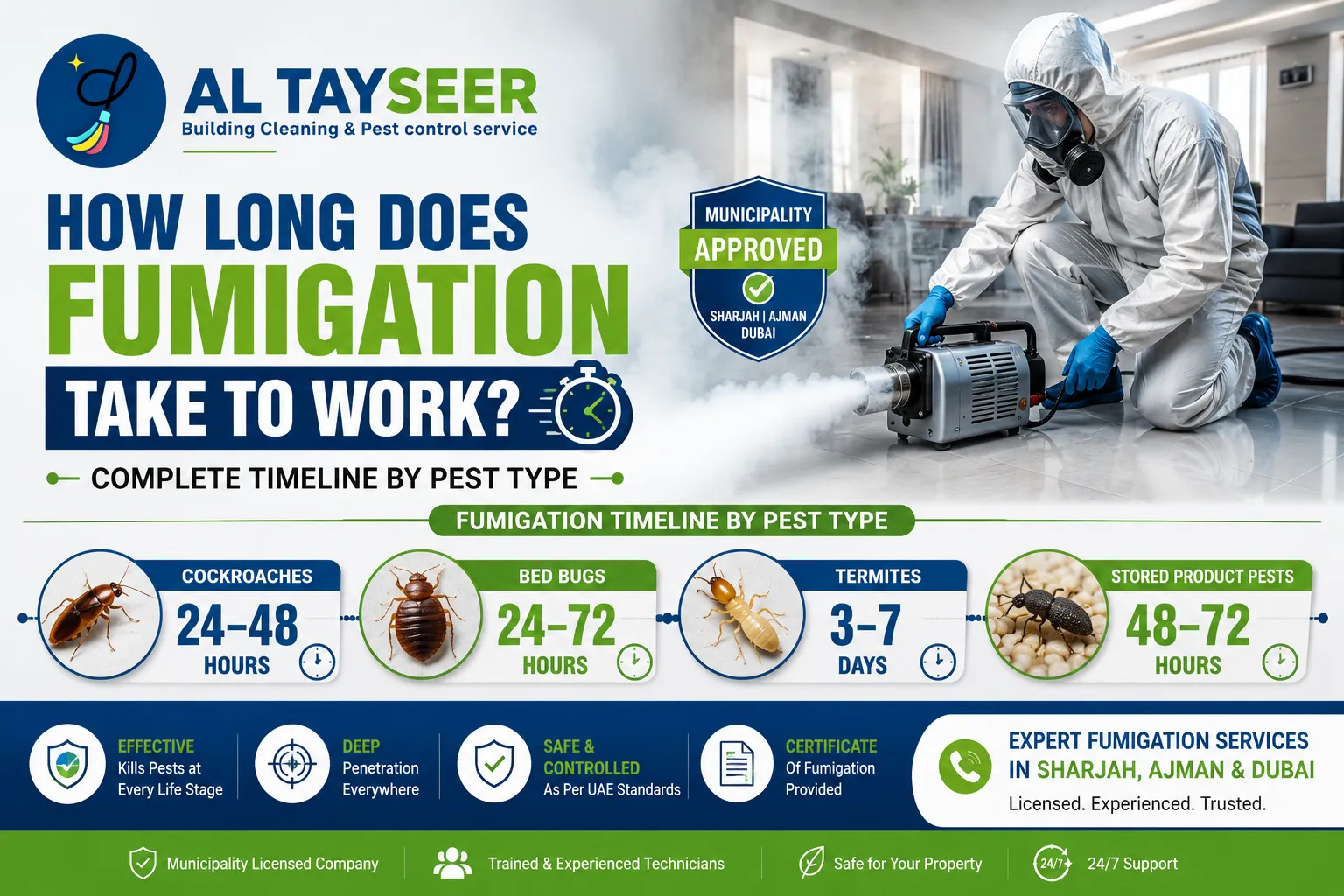
The timeline varies significantly by pest. Here is a summary before the detailed breakdown by species:
| Pest | Gas Exposure Needed | Results Visible | Re-Entry After | Follow-Up Required? |
|---|---|---|---|---|
| Cockroaches | 2–4 hours | 24–48 hours | 24 hours | Yes — 2–3 weeks (eggs) |
| Bed Bugs | 4–8 hours | 24–72 hours | 24–48 hours | Yes — 2 weeks (nymphs) |
| Termites | 24–48 hours | 3–7 days | 48–72 hours | Inspection at 30 days |
| Stored Product Pests | 24–72 hours | 48–72 hours | 48–72 hours | Depends on stock volume |
| Rodents | Not applicable | 24–48 hours | 24 hours | Yes — sealing entry points |
3. Cockroach Fumigation — How Long It Takes
Cockroach Fumigation Timeline
Fumigation for cockroaches — particularly German cockroaches in commercial kitchens and American cockroaches in drainage-connected buildings — is one of the faster fumigation treatments. The gas reaches inside wall voids, equipment interiors, and cabinet cavities where gel bait placement may be insufficient for very heavy infestations.
- Gas exposure time: 2 to 4 hours at lethal concentration
- Dead cockroaches visible: Within 24 hours of treatment
- Full colony elimination: 24 to 48 hours
- Property re-entry: After 24 hours ventilation and gas clearance check
When Fumigation Is Chosen Over Gel Bait for Cockroaches
Gel bait is the standard first-line treatment for cockroaches in most properties. Fumigation is selected when:
- The infestation is severe and spread across multiple areas of a commercial kitchen
- Previous gel treatments have not fully controlled the population
- A pre-handover or pre-inspection clean-out is required for a new commercial unit
- The property is being handed back to a landlord and needs documented pest clearance
4. Bed Bug Fumigation — How Long It Takes
Bed Bug Fumigation Timeline
Bed bugs are one of the most difficult pests to eliminate because they hide inside mattress seams, bed frames, skirting boards, electrical sockets, and even behind wallpaper — locations that contact sprays cannot reliably reach. Fumigation penetrates all of these hiding spots simultaneously.
- Gas exposure time: 4 to 8 hours
- Dead bed bugs visible: 24 to 48 hours after treatment
- Full elimination: 48 to 72 hours
- Property re-entry: After 24 to 48 hours ventilation
5. Termite Fumigation — How Long It Takes
Termite Fumigation Timeline
Termite fumigation — particularly structural tent fumigation — requires the longest exposure period of any pest treatment. This is because termite colonies are deep inside wood, and the gas must penetrate through timber to reach every colony member including the queen.
- Gas exposure time: 24 to 48 hours minimum
- Active termite movement stops: Within 24 hours of exposure
- Full colony elimination confirmed: 3 to 7 days after treatment
- Property re-entry: 48 to 72 hours after treatment with full ventilation and gas level clearance
- Inspection follow-up: 30-day post-treatment inspection to confirm colony elimination
6. Stored Product Pests and Warehouse Fumigation
Warehouse and Stored Product Pest Fumigation Timeline
Warehouses storing grain, food products, wooden packaging, or textiles are subject to infestations by stored product pests including grain weevils, flour beetles, and moth larvae. Fumigation is the only treatment method that penetrates deeply into stacked stock without requiring the entire inventory to be unpacked.
- Gas exposure time: 24 to 72 hours depending on stock density and pest species
- Pest mortality: 48 to 72 hours
- Re-entry and stock access: 48 to 72 hours after treatment
- ISPM 15 certification: Issued immediately after treatment completion for wooden packaging material
7. When Can You Re-Enter After Fumigation?
Re-entry timing is determined by the fumigant used and the results of a gas concentration measurement — not a fixed clock. A certified technician measures the gas level inside the property before anyone is allowed back in.
General Re-Entry Guidelines
- Cockroach and surface pest fumigation: Minimum 24 hours after treatment, following 4 to 6 hours of ventilation
- Bed bug fumigation: 24 to 48 hours depending on fumigant concentration used
- Termite structural fumigation: 48 to 72 hours — gas must fully dissipate from inside timber before re-entry is safe
- Warehouse fumigation: 48 to 72 hours, with gas level measurement across all stock areas
8. What to Expect After Fumigation
Knowing what is normal after fumigation helps property owners and business managers avoid unnecessary concern and prepare correctly for re-occupancy.
Dead Pests on Surfaces
Finding dead cockroaches, bed bugs, or other pests on floors and surfaces after fumigation is completely normal and is actually confirmation that the treatment has worked. Dead insects should be swept and disposed of. There is no risk from handling them after treatment.
No Residual Protection
Fumigation eliminates the existing infestation but leaves no residual pesticide barrier on surfaces. This means pests that enter the property after fumigation — from neighbouring units, drains, or outdoor areas — are not affected. For ongoing protection, especially in multi-unit buildings in Sharjah and Dubai, a follow-up residual spray or gel bait contract is recommended alongside fumigation.
Odour
Professional fumigants used by licensed UAE companies are odourless or have a very faint smell that dissipates during the ventilation period. If any odour is detected after clearance, continue ventilating and contact your pest control company before re-occupying.
Food and Surfaces
Food items, utensils, and cutlery that were properly sealed or removed before treatment do not need any additional cleaning. Open food items that were accidentally left inside should be discarded. Kitchen surfaces, counters, and equipment can be wiped down with a damp cloth before use as a standard hygiene precaution.
9. Is One Fumigation Treatment Enough?
For most pest infestations, a single professional fumigation eliminates the active population when the property is properly sealed during treatment. However, certain situations require a follow-up:
- German cockroaches: Follow-up gel bait at 2 to 3 weeks to catch nymphs hatching from egg cases that resisted the gas
- Bed bugs: Follow-up inspection at 2 weeks — eggs laid before treatment may hatch after fumigation is complete
- Multi-unit buildings: Pests can re-enter from untreated neighbouring units through shared drainage and wall gaps — a single treatment of one unit will not provide permanent protection in a shared building
- Termites with underground colonies: Above-ground colony is eliminated by fumigation but subterranean tunnels and queen chambers require soil treatment
10. Commercial Fumigation in Sharjah, Ajman and Dubai
For commercial properties, fumigation timing has to work around business operations. Al Tayseer schedules all commercial fumigation to minimise downtime — typically carrying out treatment after closing hours so the property is cleared and ready for re-entry before the next business day.
Restaurants and Food Businesses
- Treatment carried out after last service of the day — typically starting at 11 PM
- Gas exposure: 2 to 4 hours
- Ventilation: 4 to 6 hours
- Clearance and certificate issued: Before 8 AM opening time
- Treatment certificate submitted directly to municipality for compliance records
Hotels and Hospitality
- Room-by-room fumigation scheduled around occupancy — affected rooms blocked for 24 hours
- Common areas treated during lowest-traffic overnight periods
- Full documentation provided for hotel management and municipality inspection
Warehouses — Sharjah Industrial Areas and Ajman Free Zone
- Warehouse sealed and fumigated over 48-hour period
- Stock access restored after gas clearance measurement across all zones
- ISPM 15 certificate issued for wooden packing material if required
Municipality-approved fumigation for homes, restaurants, hotels, warehouses and commercial properties across Sharjah, Ajman and Dubai. 90-day warranty. After-hours scheduling available.
Get a Free Quote Commercial Services11. FAQs — How Long Does Fumigation Take to Work
Fumigation typically takes 24 to 72 hours to fully work, depending on the pest type. The gas begins killing pests within 2 to 6 hours of exposure. Full colony elimination — including juveniles — is confirmed within 24 to 72 hours. Termite fumigation takes the longest at 3 to 7 days for confirmed results.
A minimum of 24 hours for most cockroach and surface pest treatments. Bed bug and termite fumigation requires 48 to 72 hours. Re-entry is confirmed only after the technician measures gas levels and issues a clearance — not based on time alone.
For most species, yes. Professional fumigants at correct concentration and exposure time are effective against eggs for termites, bed bugs, and most cockroach species. German cockroach egg cases can be more resistant, which is why a follow-up gel bait treatment is recommended at 2 to 3 weeks after fumigation.
Licensed UAE pest control companies use professional-grade fumigants that are odourless or have a very faint smell that fully dissipates during the ventilation period — typically 4 to 6 hours. After clearance, there should be no noticeable smell inside the property.
Cockroach fumigation requires 2 to 4 hours of gas exposure and 24 hours of ventilation before re-entry. Dead cockroaches are visible within 24 to 48 hours. A follow-up treatment at 2 to 3 weeks is recommended to eliminate nymphs hatching from any egg cases that survived the gas.
For most infestations in a properly sealed property, yes. German cockroaches and bed bugs may require a follow-up visit at 2 to 3 weeks to catch newly hatched nymphs. Multi-unit buildings are the main exception — pests can re-enter from untreated units through shared drainage, so ongoing contracts provide more reliable long-term protection.
No. Fumigation in the UAE is a licensed professional activity. Fumigants are regulated chemicals that require certified handling, protective equipment, gas measurement devices, and a municipality licence to purchase and use. DIY fumigation is illegal and dangerous. Only use a municipality-approved pest control company for fumigation.
Fumigation cost depends on property size, pest type, and the fumigation method used. Contact Al Tayseer for a free site assessment and quote — pricing is provided per treatment with no hidden charges, and the fumigation certificate is included in the cost.