
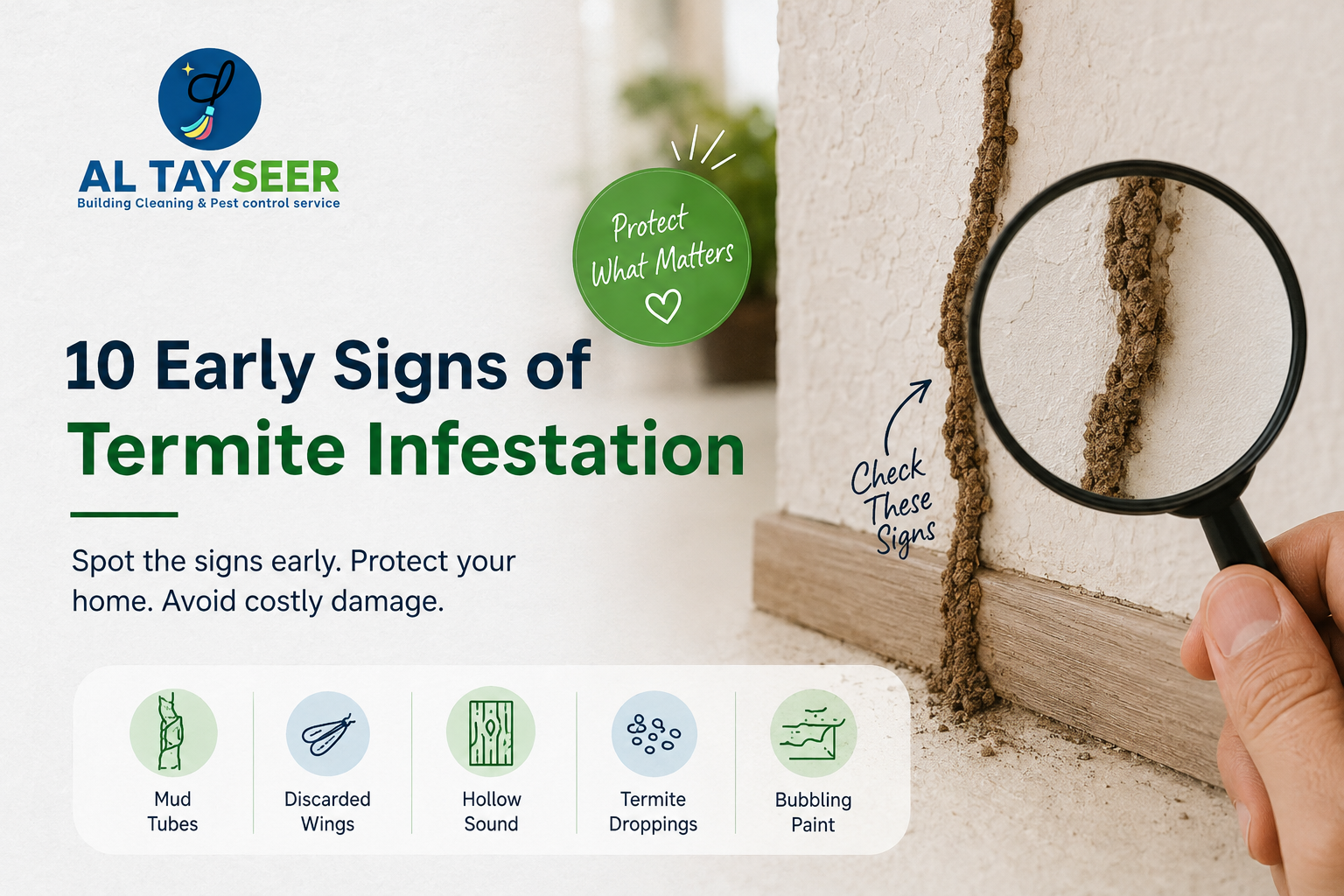
10 Early Signs of a Termite Infestation in Sharjah, Ajman & Dubai
How do you know if you have termites? Look for pencil-width mud tubes on walls, discarded wings near windows, wood that sounds hollow when tapped, and tiny pellet-like droppings. Termites work out of sight, so these small clues are often the only warning you get before the damage turns serious.
In the UAE, warm weather, garden irrigation, leaking AC drain lines and older buildings give colonies exactly what they need. Below are the 10 early signs to look for, where to find each one, and what to do next.
Quick answer: the 10 early signs
- Mud tubes on walls, foundations or pipes
- Discarded wings near windows and doors
- Flying termites (swarmers) indoors
- Hollow-sounding wood
- Frass (termite droppings)
- Bubbling or peeling paint
- Doors and windows that suddenly stick
- Soft, sagging or layered wood
- Tiny holes in wood or walls
- Clicking or rustling sounds inside walls
What Are the Early Signs of Termites in Your Home?
What do termite mud tubes look like?
Mud tubes are narrow, brown tunnels made of soil and termite saliva, usually about the width of a pencil. Subterranean termites build them to travel between the ground and your woodwork while staying moist and hidden. Check the base of exterior walls, garden walls, door frames and the points where plumbing enters the building.
Mississippi State University Extension advises having the building professionally inspected if you find shelter tubes, even when no live termites are visible (source). Keep in mind that drywood termites do not build mud tubes, so not seeing them does not mean you are in the clear.
Why are there tiny wings on my windowsill?
After a swarm, winged termites shed their wings and start new colonies. The wings are translucent, all about the same size, and often collect in small piles on windowsills, near door thresholds, under light fittings or in spider webs. Piles of shed wings are one of the few outward signs you will see before wood damage appears.
What does it mean if flying insects appear indoors?
Flying termites, called swarmers, are reproductive adults leaving a mature colony to start a new one. They are drawn to light, so you may notice them around lamps or windows at dusk. Finding swarmers inside suggests a colony is active somewhere nearby, possibly inside the building itself. Check them against flying ants using the table further down.
How can you tell if wood is hollow?
Tap door frames, skirting boards, window sills and wardrobe panels with the handle of a screwdriver. Termites eat wood from the inside and leave a thin outer layer, so affected timber sounds dull, papery or hollow compared with solid wood nearby.
What is termite frass?
Frass is the droppings of drywood termites: tiny, hard pellets that look like sand or coffee grounds. Drywood termites push it out through small holes, so it collects in little mounds beneath window frames, furniture and skirting. The pellets match the colour of the wood they ate, ranging from light tan to dark brown. The University of Florida's IFAS Extension describes these signs in its guide to drywood and dampwood termites.
Why is the paint bubbling on my wall or door frame?
Blistering or peeling paint can mean termites are tunnelling just beneath the surface, where they add moisture and weaken the finish. It looks a lot like water damage, which is why it gets misread. If the bubbling sits near wood and feels hollow or crumbles when pressed, treat it as a possible termite sign.
Why are my doors and windows suddenly sticking?
Frames can warp when termites tunnel through them and release moisture, so doors and windows that used to close easily start to stick. Humidity alone can do this too, so a stiff door only counts as a warning sign when it appears together with another sign on this list.
What does termite-damaged wood look like?
Damaged timber may feel soft, crumble when you press a screwdriver into it, or show thin tunnels running along the grain with a layered look. Floors can feel slightly spongy or sag. Inspect kitchen cabinets, wardrobes and door frames, especially along external walls and near any past leaks.
What are the small holes in my wood or walls?
Pinhead-sized holes, sometimes plugged with mud or surrounded by fine pellets, can be exit points for drywood termites. Similar holes are also made by wood-boring beetles, which need a different treatment, so it is worth confirming what you have. Our guide to wood borer control in Sharjah and Ajman explains how the two differ.
Can you hear termites inside walls?
In a quiet room at night, a faint clicking or rustling sound inside a wall can come from termites moving and feeding. This sign is easy to miss and not conclusive on its own, but combined with any of the signs above it is a good reason to book an inspection.
Are They Termites or Flying Ants?
Swarming termites and flying ants look alike at first glance, but they are different pests and need different treatment. Check these three features:
| Feature | Flying termite | Flying ant |
|---|---|---|
| Body shape | Thick, straight body with no narrow waist | Clearly pinched waist |
| Antennae | Straight, beaded | Bent or elbowed |
| Wings | Two pairs of equal length | Front wings longer than back wings |
Where Should You Check First in a UAE Property?
Termites need moisture, shelter and a cellulose food source, so start your inspection where those meet. Our Sharjah termite control page lists the factors that raise risk: leaking pipes, high humidity, wood touching soil, cracks in foundations and properties more than 20 to 25 years old without prior treatment.
| Spot to check | What to look for |
|---|---|
| Ground-floor door frames and skirting | Hollow sound, blistered paint, mud tubes at the base |
| Garden walls, planters and irrigated beds | Mud tubes running from soil to the building |
| Under sinks and around AC drain lines | Damp wood, soft panels, small holes |
| Wardrobes and kitchen cabinets on outer walls | Frass piles, layered or crumbling wood |
| Storage rooms with cardboard and paper | Tunnelled boxes, mud on stored items |
| Windowsills and light fittings | Discarded wings, dead swarmers |
What Should You Do If You Spot These Signs?
- Photograph and note the location. Take clear photos of tubes, wings or droppings so a technician can see exactly what you found.
- Avoid DIY sprays. Store-bought products often fail to eliminate the whole colony and can be unsafe if misapplied.
- Fix moisture problems. Repair leaking pipes and AC drain lines, and keep irrigation away from walls and wooden elements.
- Book a professional inspection. A licensed technician can identify the species, trace the colony and recommend the right treatment. Our guides on anti-termite treatment in the UAE and post-construction anti-termite treatment explain the options.
Frequently Asked Questions
What is the first sign of termites in a house?
The first visible signs are usually pencil-width mud tubes on walls or foundations, or small piles of discarded wings near windows and doors. Termites stay hidden inside soil, tubes and wood, so these small clues often appear before any visible damage.
How can I tell termites from flying ants?
Flying termites have a thick, straight body, straight antennae and two pairs of wings of equal length. Flying ants have a pinched waist, elbowed antennae and front wings that are longer than the back wings.
Can termites be in my walls without any visible signs?
Yes. Termites feed inside wood and behind plaster, so a colony can be active for a long time before any mud tubes, droppings or damage become visible. A professional inspection is the only reliable way to confirm.
Do termites only eat wood?
No. Termites feed on cellulose, which is found in wood, paper, cardboard and many other plant-based materials. That is why stored boxes, books and wooden furniture can also be affected.
Will a store-bought spray get rid of termites?
Rarely. Over-the-counter sprays usually kill only the termites you can see and do not reach the colony hidden in soil or inside wood. Professional treatment targets the colony itself and the areas where it enters the building.
Book a Termite Inspection in Sharjah, Ajman or Dubai
Seen one of these signs? Do not wait for the damage to show. Our licensed technicians will inspect your property, confirm the cause and plan a safe, lasting treatment.
Call: +971 564 041 007 WhatsApp Us NowAlso see: Sharjah Pest Control | Ajman Pest Control | Dubai Pest Control