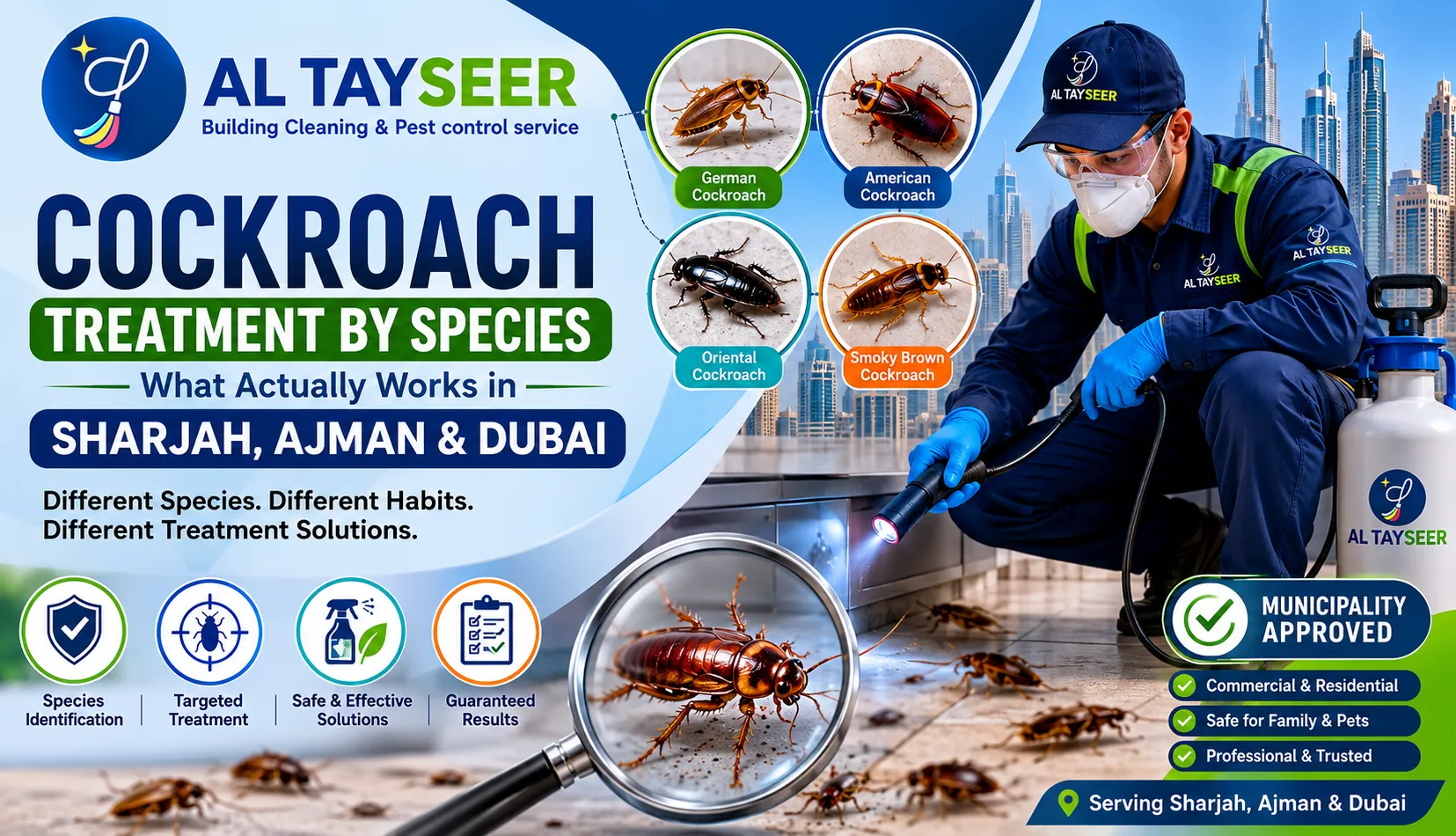
Cockroach Treatment by Species: What Actually Works in Sharjah, Ajman and Dubai
The most common reason cockroach treatments fail is simple: the wrong method was used for the wrong species. A gel bait placed in a kitchen will not touch a Smoky Brown cockroach nesting on the roof. A spray applied to visible surfaces will not reach a German cockroach colony living inside a wall cavity. In Sharjah, Ajman, and Dubai — where multiple species are active year-round — getting the treatment right starts with knowing exactly what you are dealing with.
This guide covers the correct professional treatment method for each of the 5 cockroach species found across the region, including which methods are required for commercial premises under municipality regulations, and when fumigation is the right call versus targeted gel or residual spray.
1. Why Treatment Differs by Species
Every cockroach species has a different nesting location, food preference, activity pattern, and reproductive cycle. A treatment plan built around these factors outperforms any generic spray-and-hope approach because it targets the colony at the source rather than just the individuals that happen to be visible.
The three variables that determine treatment method are:
- Where they nest — kitchen voids vs drainage vs outdoor roof spaces
- How fast they breed — German cockroaches need faster, repeated intervention than Smoky Brown species
- How they enter — sealing entry points is essential for drain-entering or outdoor species but irrelevant for species already nesting inside
2. German Cockroach Treatment
German Cockroach (Blattella germanica)
Recommended Treatment Methods
How It Works
Gel bait is the primary weapon against German cockroaches. Small dots of professional-grade gel are placed deep inside cabinet hinges, under appliances, behind sinks, and inside electrical outlet cavities — directly in the cockroach's daily travel routes. The bait works through secondary kill: roaches consume it, return to the nest, and their droppings and bodies then poison other colony members, including those that never left the nesting site.
Insect Growth Regulators (IGRs) are added to prevent egg capsules from hatching, which is the reason many DIY treatments fail — sprays and baits kill adults but leave eggs untouched. A complete treatment addresses all three: adults, juveniles (nymphs), and eggs.
Treatment Frequency
- Initial treatment + follow-up inspection at 2–3 weeks
- For restaurants and commercial kitchens in Dubai and Sharjah: monthly contract recommended
- Severe infestations may require 2–3 visits over 6–8 weeks
3. American Cockroach Treatment
American Cockroach (Periplaneta americana)
Recommended Treatment Methods
How It Works
American cockroaches live and breed in the drainage and sewer system, not inside the home itself. Treatment focuses on two things: killing those that enter through drains using drain-applied residual insecticide, and sealing the physical entry points — floor drain covers, gaps around toilet base pipes, and gaps around sink plumbing — to stop re-entry.
A perimeter spray is applied around the exterior base of the building and any ground-level entry gaps, creating a treated barrier that kills roaches before they get inside. Gel bait alone is largely ineffective for this species because the nesting population lives outside the treatment zone.
Treatment Frequency
- Initial treatment + physical sealing of entry points
- Quarterly follow-up for ground-floor commercial units in Dubai and Sharjah
- Monthly for food businesses with ground-floor drainage access
4. Oriental Cockroach Treatment
Oriental Cockroach (Blatta orientalis)
Recommended Treatment Methods
How It Works
Oriental cockroaches are moisture-dependent. Treatment without addressing the water source is almost always temporary — they will recolonize any area that stays damp enough. A professional inspection identifies moisture sources first (leaking pipes, condensation points, inadequate drainage), then applies residual spray and boric acid dust to affected areas including basements, storage rooms, and under-sink cavities.
Boric acid dust is particularly effective for Oriental cockroaches in wall voids and beneath flooring where spray penetration is limited. It has no repellent effect so cockroaches continue walking through it and carry it back to the nest on their bodies.
Treatment Frequency
- Initial treatment + moisture remediation advice
- Follow-up at 3–4 weeks to confirm moisture reduction is working
- Bi-annual treatment for older Sharjah and Ajman villas with known damp areas
5. Brown-Banded Cockroach Treatment
Brown-Banded Cockroach (Supella longipalpa)
Recommended Treatment Methods
How It Works
Brown-Banded cockroaches hide high up and away from food and water sources — inside wall clocks, behind picture frames, inside TV units, inside electrical appliances, and along ceiling corners. Standard kitchen-focused gel bait placement misses them entirely, which is why many residents report treatment not working when this is the actual species.
Treatment involves gel bait placed at elevated positions throughout the property — bedrooms, living rooms, and office spaces — combined with a residual spray targeting non-food areas. Electronics are carefully inspected because this species frequently nests inside warm appliances, and an untreated appliance will restart the infestation within weeks.
Treatment Frequency
- Initial full-property treatment including bedrooms and living areas
- Follow-up at 2–3 weeks — critical for this species due to elevated hiding
- For furnished offices and corporate spaces: quarterly contract recommended
6. Smoky Brown Cockroach Treatment
Smoky Brown Cockroach (Periplaneta fuliginosa)
Recommended Treatment Methods
How It Works
Smoky Brown cockroaches are primarily an outdoor species that enters homes through open windows, balcony gaps, roof vents, and poorly sealed door frames — particularly in Sharjah and Dubai villas. Indoor treatment addresses only the individuals that have entered, not the nesting colony outside.
Effective control requires treating the outdoor perimeter, roof spaces, garden mulch areas, and tree lines with a residual spray, combined with physical sealing of identified entry gaps. Light management also helps — switching off outdoor lights that attract flying roaches at night reduces entry significantly, particularly in summer months.
Treatment Frequency
- Initial perimeter treatment + entry point inspection
- Bi-annual treatment for villas with garden areas in Sharjah and Dubai
- Pre-summer treatment recommended before heat drives outdoor populations indoors
7. Treatment Method Comparison Table
| Species | Primary Method | Where Applied | Follow-Up Needed | Commercial Frequency |
|---|---|---|---|---|
| German | Gel bait + IGR | Kitchen, cabinets, wall voids | 2–3 weeks | Monthly |
| American | Drain + perimeter spray | Drainage, exterior base | Quarterly | Monthly (food businesses) |
| Oriental | Residual spray + boric dust | Damp areas, basements | 3–4 weeks | Bi-annual |
| Brown-Banded | Elevated gel + residual spray | Bedrooms, electronics, living areas | 2–3 weeks | Quarterly |
| Smoky Brown | Perimeter + roof spray | Outdoors, roof, garden | Bi-annual | Bi-annual |
8. Commercial Properties — What Municipality Requires
For commercial properties across Sharjah, Ajman, and Dubai, cockroach control is not optional — it is a legal compliance requirement. The specific treatment protocol required depends on the type of business:
Restaurants and Food Businesses
- Monthly professional treatment minimum
- German cockroach gel bait as primary method — no odor, no shutdown required
- Treatment certificate issued for municipality inspection
- Kitchen, storage, and drainage areas all covered in a single visit
Offices and Corporate Spaces
- Quarterly treatment standard — more frequent if Brown-Banded species detected
- Gel bait and IGR preferred — no spray residue on surfaces or equipment
- Treatment can be carried out after hours with no disruption to business operations
Warehouses and Industrial Units — Sharjah and Ajman
- Bi-annual minimum, quarterly for food storage or packaging facilities
- American cockroach drainage treatment included as standard
- Large-area residual spray for perimeter and loading areas
Labour Accommodation and Residential Buildings
- Quarterly treatment required for shared residential buildings
- German and American cockroach combined protocol applied across all units
- Yearly contracts available with priority scheduling
Our full range of commercial pest control services covers all property types across Sharjah, Ajman, and Dubai with treatment certificates, scheduled contracts, and after-hours availability.
9. When Is Fumigation Required?
Fumigation is not always the right answer for cockroaches — and for most species, it is not the first choice. Here is when it is genuinely required:
- Severe German cockroach infestations in commercial kitchens where gel bait alone cannot reach all nesting sites
- Warehouses with mixed-species infestations affecting large floor areas and stored goods
- Pre-handover treatments for newly fitted-out restaurants and commercial units in Dubai and Sharjah
- ISPM 15 wood packaging treatment — a specific fumigation requirement for import/export businesses handling wooden pallets and crates
10. Treatment Warranty and Follow-Up
Every cockroach treatment by Al Tayseer comes with a 90-day warranty. If cockroaches return within the warranty period, the team returns and retreats at no additional cost. This applies to both residential and commercial treatments across Sharjah, Ajman, and Dubai.
Follow-up visits are scheduled as part of the treatment plan — not just offered as an upsell. The follow-up timing is species-specific: German cockroach follow-ups happen at 2–3 weeks (before the next egg hatch cycle), while outdoor species like Smoky Brown are re-inspected bi-annually.
Municipality-approved cockroach treatment for homes, restaurants, offices and warehouses across Sharjah, Ajman and Dubai. 90-day warranty. Same-day response available.
Get a Free Quote Commercial Services11. FAQs
Gel bait treatment is the industry standard for restaurants because it requires no shutdown, leaves no visible residue on food surfaces, and reaches inside the cabinet and equipment cavities where German cockroaches nest. Monthly professional treatment is required by Dubai Municipality for all food businesses.
Gel bait treatments typically show a significant reduction in activity within 24–72 hours. Full control of an established German cockroach infestation usually takes 2–4 weeks across 2 visits. Drain-entering American cockroaches are controlled faster once entry points are sealed.
Yes — professional-grade gel baits used by municipality-approved companies are formulated for use in food-handling environments. They are applied in precise, targeted spots away from direct food contact and are approved for use in commercial kitchens by Sharjah, Ajman, and Dubai municipalities.
For gel bait treatment, no — residents can stay in the property. For spray-based or fumigation treatments, a short vacating period is required. Al Tayseer advises on the exact requirements based on the treatment method before every visit.
The certificate records the date of treatment, the property address, the pest species treated, the products used, and the technician details. It is accepted by Sharjah Municipality, Ajman Municipality, and Dubai Municipality for compliance inspections.
In multi-unit buildings, cockroaches can re-enter from neighbouring units through shared plumbing and drainage even after a successful treatment. This is why annual or quarterly contracts are recommended for apartments and commercial buildings — they maintain a treated barrier rather than starting from zero each time.
Commercial treatments are scaled for larger areas, include municipality compliance certification, and are scheduled to avoid business disruption. Treatment frequencies are higher for commercial premises — monthly for food businesses versus quarterly or annual for residential properties.