
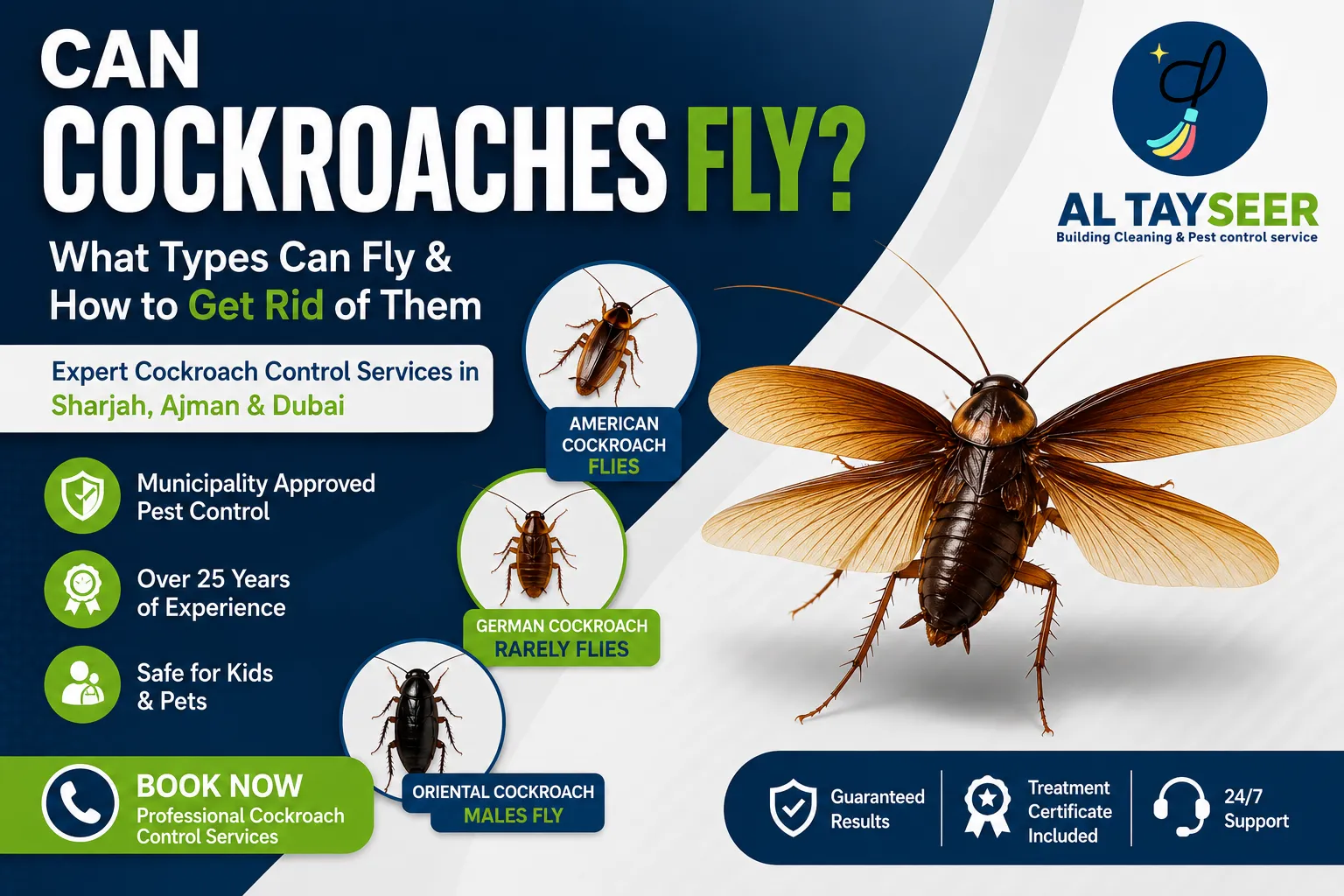
Can Cockroaches Fly? What Types Can Fly & How to Get Rid of Them
You open a cabinet, a large brown shape launches itself directly at your face, and your evening is done. It happened fast — and yes, that was a cockroach in flight.
This is one of the most common pest shocks reported by homeowners in Dubai, Sharjah, and Ajman — especially between June and September. Most people don't realise that roaches have wings until they use them. And when UAE temperatures climb, they will.
This guide covers exactly which types can fly, what makes them take off, and what you need to do to eliminate them from your home or business permanently.
1. Can Cockroaches Really Fly?
Yes — but most choose not to. Almost all common roach species have wings. The problem is that having wings doesn't mean they use them. Cockroaches are reluctant fliers. They'll nearly always choose to run rather than take off — flight only happens when they're startled, overheating, or trying to escape fast.
In the UAE's extreme summer climate, heat is the main trigger. When indoor or outdoor temperatures rise above 35–38°C, cockroaches become significantly more likely to fly. If you've noticed winged roaches appearing more frequently in July, August, and September — that's exactly why.
One more thing worth knowing: cockroaches don't sustain flight the way birds or insects do. They glide rather than flap. A disturbed cockroach will launch itself, glide across the room, and land — usually somewhere near a light source or an exit. It feels deliberate. It's pure instinct.
2. What Types of Cockroaches Can Fly?
There are 3 types of cockroaches commonly found in UAE properties that have wings and the ability to fly. Each one behaves differently, lives in different parts of your property, and requires a different elimination approach.
3. American Cockroach
The American Cockroach is the largest cockroach you're likely to encounter in a UAE property — and the one most likely to fly at you. It's reddish-brown, grows to 4–5 cm in length, and those large wings are fully functional. When temperatures exceed 38°C or the roach is suddenly disturbed, it will glide short distances — almost always toward a nearby light source.
| Size | 3.5 – 5 cm |
| Colour | Reddish-brown; pale yellow figure-8 pattern behind the head |
| Flight behaviour | Glides when startled or overheated; triggered above 38°C |
| Where found in UAE | Sewers, drainage pipes, basement car parks, restaurant kitchens, garbage rooms |
| Entry points | Floor drains, sewer pipes, gaps around plumbing penetrations |
| Active hours | Nocturnal — most active after midnight |
| Health risk | Carries Salmonella, E. coli, and over 30 types of bacteria |
Why It's So Common in Sharjah, Dubai & Ajman
The UAE's shared drainage networks are essentially a highway for American Cockroaches. They move between apartments and commercial buildings through shared sewer lines, floor drain pipes, and building ventilation shafts. Seeing one of these roaches in your kitchen doesn't mean your home is dirty — it almost certainly came up through a drain or a gap around pipework under your sink.
4. German Cockroach
The German Cockroach is the most common cockroach inside UAE kitchens and bathrooms — and arguably the hardest to eliminate. It's small, fast, and breeds at a rate that makes DIY control genuinely ineffective without professional intervention. Both males and females have wings, but they almost never fly. They don't need to — they survive by running through cracks that are fractions of a millimetre wide and hiding in places most people don't think to look.
| Size | 1.2 – 1.5 cm |
| Colour | Light tan/brown with two dark parallel stripes behind the head |
| Flight behaviour | Almost never flies — prefers running at speed through tight spaces |
| Where found in UAE | Kitchen hinges, under fridges, inside electrical appliances, behind stoves, in wall cracks |
| Breeding rate | One female produces up to 400 offspring in her lifetime |
| Spray resistance | Developing resistance to many common aerosol insecticides |
| Health risk | Major asthma trigger; spreads Salmonella across food surfaces |
Why German Cockroaches Are the Hardest to Eliminate
Their breeding speed is what makes them so difficult. A single pregnant German roach entering your kitchen can result in thousands of offspring within months. They've also built resistance to many aerosol sprays — which is exactly why supermarket cans rarely fix the problem. Professional-grade cockroach killing gel is the preferred treatment in the UAE because it bypasses spray resistance entirely. The gel is placed inside hinges, behind appliances, and in cracks — cockroaches carry the active ingredient back to the nest, causing colony-level elimination. Read more about how cockroach killing gel works.
5. Oriental Cockroach
The Oriental Cockroach is dark, shiny, and slower-moving than the other two — but don't mistake that for being less of a threat. It's strongly associated with damp, decaying environments: floor drains, sewage pipes, basement utility rooms, and waste storage areas. Male Oriental Cockroaches have shorter wings that cover about three-quarters of the abdomen and can fly short distances when disturbed. Females have small, non-functional wing pads and cannot fly at all.
| Size | 2 – 3 cm |
| Colour | Very dark brown to black; shiny, smooth surface |
| Flight behaviour | Males can fly short distances; females have no functional wings |
| Where found in UAE | Drains, sewers, garbage chutes, basements, damp utility corridors |
| What attracts it | Decaying organic matter, moisture, darkness — not common in kitchens |
| UAE relevance | Often found in commercial buildings, food warehouses, and older villa drains |
| Health risk | Heavy contaminator of water sources; linked to dysentery and gastroenteritis |
Where You're Most Likely to Find It in UAE Properties
Oriental Cockroaches don't tend to infest kitchens the way German Cockroaches do. They prefer basement car parks, ground-floor utility rooms, waste chutes, and outdoor drains — which is why they're often found in commercial buildings, warehouses, and older Sharjah villa compounds. Their presence in drainage areas makes them a serious contamination risk for shared water infrastructure in multi-unit residential buildings.
6. What Triggers Cockroaches to Fly?
Understanding what makes cockroaches take flight helps you reduce the chances of an unpleasant encounter — and explains why infestations feel worse during UAE summers.
- Extreme heat: The primary trigger in the UAE. Cockroaches become far more active — and significantly more likely to fly — when temperatures exceed 35°C. July, August, and September see the highest reported flying roach incidents across Dubai, Sharjah, and Ajman.
- Sudden light: Turning on a light in a dark room startles resting cockroaches. Their immediate response is to fly toward the nearest exit or another light source — which is why a flying roach appears to head straight at you when you flip a switch.
- Direct threat: Being sprayed, chased, or suddenly disturbed triggers an immediate flight response in the American and Oriental cockroach species in particular.
- Overcrowding: When an infestation grows large enough that food and hiding spots run short, cockroaches will fly in search of new territory. A flying roach during the day is often a sign of a very large infestation below.
- AC and ventilation airflow: Air units and open ventilation grilles can physically carry lightweight roaches between rooms or floors in shared residential and commercial buildings.
7. How to Get Rid of Flying Cockroaches
A roach that can fly is still just a roach. The same professional elimination methods work for all three types — the key is applying them correctly and targeting the right locations for each species. Here's what actually works in UAE properties.
-
Identify the species first
Treatment differs by type. German Cockroaches need gel bait placed in hinges and appliance gaps. American and Oriental Cockroaches need drain treatment, crack sealing, and entry-point closure. Treating the wrong species in the wrong location wastes time and money and lets the real problem continue to grow. -
Seal every entry point
Use silicone sealant around all pipe penetrations, cable holes, and gaps in skirting boards. Install drain covers or mesh over floor drains — essential for blocking American and Oriental Cockroaches travelling up from shared sewer systems. Check gaps around AC pipe penetrations in the wall; they're a major route in UAE apartments. -
Apply professional gel bait — not aerosol sprays
Gel baits are the professional standard for indoor cockroach control. They're odourless, safe around children and pets when applied correctly, and highly effective against species that have developed spray resistance. The bait is applied in small amounts inside hinges, behind appliances, and in cracks — cockroaches carry the active ingredient back to the nest, causing colony-level elimination. Read more about how cockroach killing gel works. -
Target the nesting zones, not the open surfaces
Spraying visible surfaces is mostly ineffective. Cockroaches live inside appliances, in wall voids, in drain pipes, and in cracks far too small to spray into. Effective treatment requires getting the product into where they actually breed. Professional inspection with the right tools locates nests behind walls, under floors, and inside false ceilings. -
Prevent re-entry with environmental changes
Fix any leaking pipes immediately — cockroaches can survive a month without food but die within a week without water. Store all food in sealed containers. Take out rubbish daily and keep kitchen surfaces dry overnight. For a full list of what conditions cockroaches actively avoid, see our guide on what cockroaches hate most.
8. When to Call a Professional in Sharjah, Ajman or Dubai
Most supermarket sprays work for two or three days before roaches simply relocate to untreated areas and return once the residue fades. The underlying nest — often deep inside a wall void, under a concrete floor, or within shared drainage infrastructure — stays completely untouched.
Professional cockroach control goes further. Our team at Al Tayseer uses municipality-approved methods that combine gel baiting, crack-and-crevice treatment, and residual spray to cut off the entire colony. For residential pest control in apartments and villas, we also provide follow-up visits as part of the treatment guarantee — because a single missed egg case can restart the infestation.
For commercial properties — restaurants, warehouses, hotels, food businesses — the risk is higher. One roach spotted by a customer or a municipality inspector causes serious, immediate damage. Our cockroach pest control services across Sharjah, Dubai, and Ajman are fully municipality-approved, and we issue official treatment certificates after every visit — essential for food business compliance and municipality inspections.
Cockroaches in Your Property?
Municipality-approved cockroach control for homes and businesses across Dubai, Sharjah & Ajman. Over 25 years of experience. Services from AED 120. Treatment certificate included.